
Part Two · The Stack · Layer 6 of 9
The Reagents Layer — The Recurring-Revenue Floor
Every layer we have covered so far sells the same promise: better molecules, chosen faster. The reagents layer sells something duller and more durable. It sells the physical inputs a scientist consumes to run a single experiment, and it gets paid whether that experiment works or not. This is the least glamorous floor in the drug-discovery building, and for a certain kind of investor it is the most interesting one, precisely because its revenue does not depend on any drug ever reaching a patient.
Start with what a reagent actually is. When a biologist wants to know whether a particular protein is present in a cell, or how much of it there is, they cannot see the protein directly. They use an antibody, a molecule engineered to bind one specific target, tagged with something detectable, such as a fluorescent dye or an enzyme that produces color. Add the antibody, wash away what does not stick, and measure the signal. That is the core of most protein detection in a research lab, and every run consumes antibody that has to be repurchased. Assay kits package this logic into a ready-made bundle of reagents for a specific measurement. Recombinant proteins, proteins manufactured in engineered cells rather than extracted from tissue, are the standardized inputs and controls that make those measurements comparable across labs.
The list of consumables runs deeper than most generalists assume. Cells do not grow in nothing; they grow in cell culture media, a carefully formulated liquid of nutrients, salts, and growth factors, often supplemented with animal sera. Media is consumed continuously, a running cell line is a running media bill. When a biologic drug (an antibody-based therapeutic, for instance) has to be purified out of the messy soup it was grown in, that is done with chromatography resins: packed beads that selectively grab the target molecule as the mixture flows through. The workhorse here is the Protein A ligand, a molecule that binds the constant region of antibodies with high specificity, making it the default first step in nearly every antibody purification process. Filtration membranes clarify and sterilize the streams around it.
Then there is the plumbing of modern biomanufacturing. The industry has shifted heavily toward single-use, or disposable, bioprocess consumables, sterile plastic bioreactor bags, tubing, and connectors that are used once and discarded rather than cleaned and revalidated. Single-use lowers contamination risk and shortens changeover between batches, and it converts what used to be a capital-and-cleaning problem into a stream of per-batch purchases. At the highest frequency of all sits ordinary plasticware: pipette tips, microplates, tubes. A single automated screening run can burn through thousands of tips and dozens of plates. Nobody writes a research paper about the tip, but the lab cannot function for an hour without a full box.
The Economics: A Toll on Activity, Not on Success
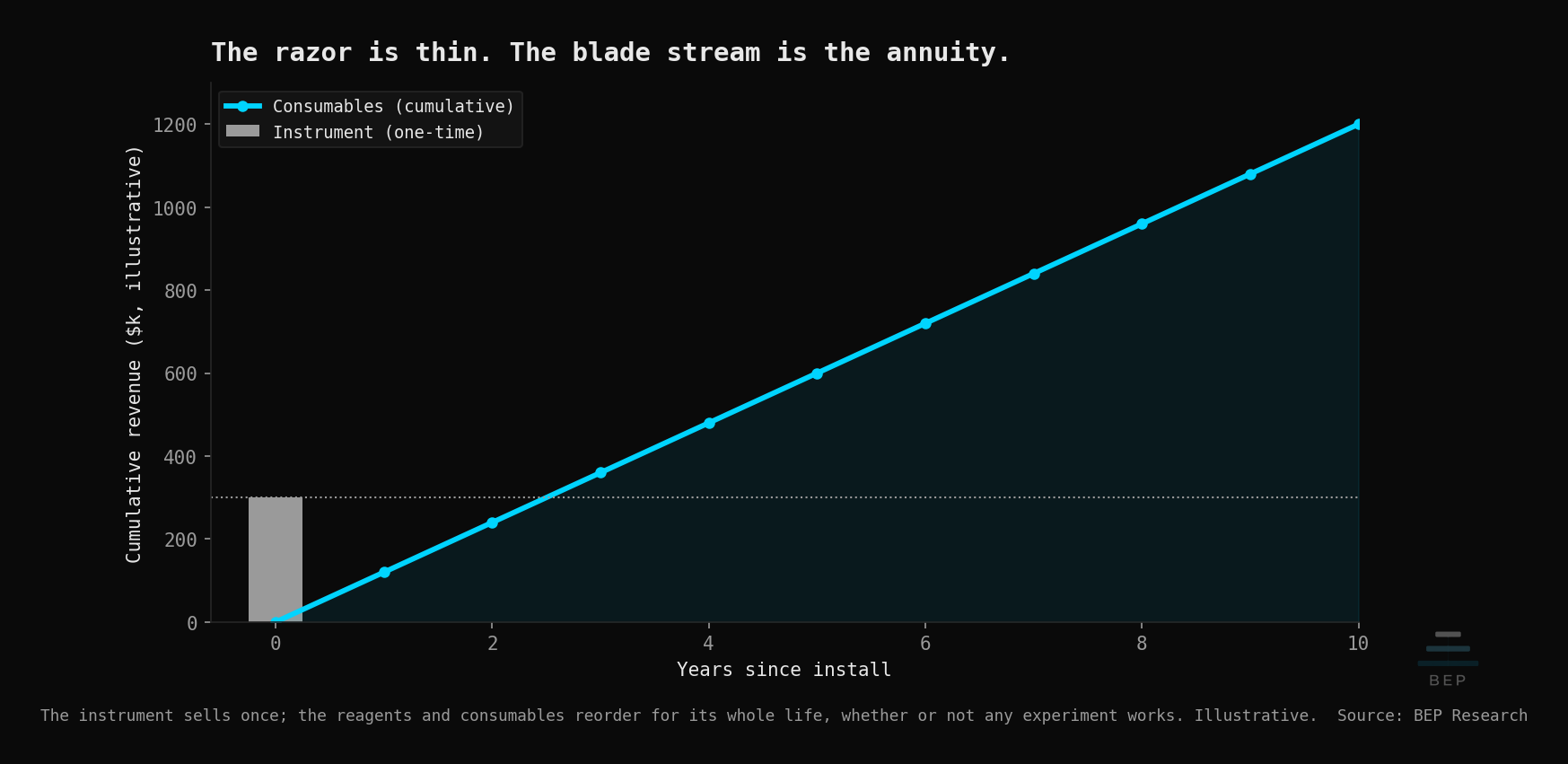
The business model here is the oldest one in industrial supply: razor-and-blade. The instruments are the razors, bought once and depreciated over years. The reagents and consumables are the blades, bought again every week for the life of the instrument. Vendors will often price the razor thin to seat it in the lab, because the installed base is really a subscription to the blade stream. A sequencer, a bioreactor, a liquid handler, each one is a decade-long annuity of tips, media, kits, and resins keyed to that vendor's ecosystem.
A handful of vendors dominate the everyday reagent and consumable order:
- Thermo Fisher (TMO), the broadest catalog in the business. Between its own brands and the Fisher Scientific distribution channel, it can supply most of a lab's recurring order from one account, which makes it structurally sticky and hard to displace item by item.
- Danaher (DHR), the bioprocess and antibody anchor. Through Cytiva it sells chromatography resins and single-use systems; through Pall it sells filtration; through Abcam it sells research antibodies. Danaher's exposure is weighted toward the biologics manufacturing chain, which ties it more tightly to the drug-production side of the toll than to the pure academic bench.
- Bio-Techne (TECH), the specialty protein leader. Its R&D Systems brand is the reference source for recombinant proteins and cytokines, the signaling molecules used to stimulate and study cells. This is a narrower, higher-margin position: not the broadest catalog, but the trusted default in categories where scientists will not switch to save a few dollars.
- Merck KGaA / MilliporeSigma (MKKGY, MRK.DE), the German Merck, which is entirely distinct from the U.S. Merck (MRK) despite the shared name; confusing the two is a common error. Its life-science arm combines Sigma-Aldrich, the dominant catalog of research chemicals and biochemicals, with Millipore filtration. Between chemicals and membranes, it touches an enormous share of the everyday reagent order.
- Avantor (AVTR), reagents plus reach. Avantor pairs its own products with the VWR distribution channel, which functions as a purchasing backbone for thousands of labs. The investment character here leans more toward channel and logistics than proprietary formulation, which makes it more distribution-cyclical than the pure product houses.
- Sartorius (SRT.DE), the cleanest single-use razor. Sartorius is heavily concentrated in disposable bioprocess consumables, bags, filters, and the fittings around them, which makes it close to a pure-play on the recurring, per-batch blade stream in biomanufacturing.
- Repligen (RGEN), small in revenue, large in position. Repligen's Protein A affinity ligands are embedded inside the purification steps of most commercial antibody processes, frequently as an ingredient sold into the larger vendors' resins. It is a picks-and-shovels supplier to the picks-and-shovels suppliers, which is an unusually defensible spot.
- Corning (GLW), the vessels biology grows in. Beyond its display and optical businesses, Corning is a major maker of labware and cell-culture surfaces: the treated flasks, plates, and dishes whose surface chemistry lets cells attach and grow. It is the physical substrate of the experiment.
- Eppendorf (private), not investable in public markets, but named because it defines a category. Eppendorf's tips, tubes, and plates are so standard that the eponymous tube is lab shorthand. It is a reminder that some of the deepest moats in this layer sit outside the public tape.
The Investment Angle, and the Honest Risk
The way to hold this layer is to be clear-eyed about what the moat is and is not. It is not, for the most part, a differentiation moat in the sense of irreplaceable science. Most individual reagents have a substitute. The moat is aggregation and habit: the breadth of the catalog, the validation history a scientist does not want to redo, the qualified supplier a manufacturer cannot swap without regulatory paperwork, and the installed instrument that dictates which blades fit. Those advantages have concentrated the economics into Thermo and Danaher at the top, with Sartorius and Repligen anchoring the bioprocess end. For an investor who believes the number of experiments only goes up, this is the layer that participates in that growth without underwriting any single molecule.
The risk is equally plain, and it is not existential, it is cyclical. Reagent demand tracks R&D budgets, and those budgets breathe with the funding environment. Biopharma spending contracts when capital tightens; academic purchasing bends with government grant cycles; and the pandemic era taught the whole sector a hard lesson about inventory, when customers who over-ordered during the boom spent the following years working down stockpiles and starving new orders. A tollbooth still collects less when the road is quiet. The reagents layer is a durable claim on scientific activity, but activity itself is fundable and therefore cyclical. The variable to watch is funding, not disruption: in a lean year the road goes quiet and the tollbooth collects less, even though the experiments themselves are never really in doubt.
↗ Explore the Reagents layer in the interactive map — every company in this layer, public and private, in one view.© BEP Holdings · Ben Pouladian. Research and commentary, not investment or medical advice.