Part One · How the Lab Works
How a Drug Actually Gets Made (and Why It's So Hard)
Before we can talk sensibly about what artificial intelligence does to drug discovery, we have to understand the thing it is being applied to. Making a medicine is not one problem. It is a chain of a dozen distinct problems, each with its own failure modes, run over the course of a decade or more, at a cost that would fund a mid-sized semiconductor fab. The industry has a dry name for the whole enterprise, the drug-discovery-and-development pipeline, and the word "pipeline" is doing a lot of quiet work. It implies smooth flow. What actually happens is closer to a gauntlet, where the great majority of candidates that enter never reach the other end.
This chapter walks the gauntlet start to finish. The goal is not to make you a pharmacologist. It is to give you a working map of where the money goes, where the years go, and where the failures cluster, because those are exactly the places where a faster, cheaper method would be worth the most.
Step One: Finding the Target
Almost every modern drug works by physically interacting with a specific molecule inside the body. That molecule is called the target. In the overwhelming majority of cases the target is a protein, a large, folded molecular machine that carries out some job in a cell. Proteins are built according to instructions written in genes, so when researchers talk about a target they are often naming either the protein itself or the gene that codes for it.
The logic of a target is simple. A disease usually involves some biological process gone wrong: a protein that is overactive, a signal that fires when it shouldn't, an enzyme that builds up a substance the body can't clear. If you can find the specific protein sitting at the center of that malfunction and interfere with it, switch it off, dial it down, block the pocket where it does its work, you may be able to correct the disease. Choosing that protein is target identification.
Identification is only half the job. The harder half is target validation: proving that hitting this particular protein will actually change the disease, and not merely correlate with it. Biology is thick with associations that turn out to be bystanders rather than causes. A protein might be elevated in sick patients simply because it responds to the illness, not because it drives it. Validation is the work of establishing causation, through genetics (do people born with a broken version of this gene get the disease, or avoid it?), through animal experiments (if we remove this protein in a mouse, does the disease improve?), and through cell studies. Weak validation is one of the deepest reasons drugs fail years later and hundreds of millions of dollars downstream: the molecule did exactly what it was designed to do to the target, and the disease didn't care, because the target was never the true lever.
Some proteins resist being drugged at all. These are the famously "undruggable" targets. A conventional drug works by lodging itself into a well-shaped pocket on the protein's surface, the way a key fits a lock. Many proteins that we know cause disease simply have no such pocket, their surfaces are smooth, or flat, or the interaction we want to disrupt is spread across a broad featureless region with nowhere for a small molecule to grab. The target is validated, the biology is understood, and there is still no obvious way to touch it. A large fraction of the human proteins implicated in cancer and other diseases sit in this undruggable bucket, and expanding what counts as druggable is one of the field's central ambitions.
Step Two: Hit Discovery
Once you have a validated target, you need a molecule that acts on it. The first crude version of such a molecule is called a hit, any compound that shows a real, measurable effect on the target when tested.
The classic way to find hits is high-throughput screening, or HTS. A large pharmaceutical company maintains a physical library of chemical compounds, often on the order of one to two million distinct molecules, stored in tiny wells across thousands of plastic plates. HTS means testing that entire library against the target, one compound at a time, using robotics to move fast. The test itself is called an assay: a controlled experiment engineered to produce a readable signal, a color change, a flash of light, a measured binding, when a compound does something to the target. Run the assay across a million compounds and you are essentially asking, at industrial scale, "does any of this stuff do anything to my protein?"
The economics of HTS are brutal in an instructive way. You might screen a million compounds and come away with a few hundred hits, and most of those will be false leads, molecules that hit the target but also react with everything else, or that only work at concentrations no living body could tolerate. The physical library, however large, is also a rounding error against the space of possible drug-like molecules, which is estimated to run into the range of 10^60, a number with no useful analogy in the physical universe. You are dredging a teaspoon and hoping the ocean cooperated.
This is why virtual screening, also called in-silico screening ("in silico" means done in a computer, by analogy with in-vitro and in-vivo, which we'll define shortly), matters even before any AI enters the story. Instead of physically testing compounds, you model the target's three-dimensional shape and use software to predict which molecules might fit it, then only synthesize and test the promising ones. Virtual screening lets you search libraries far larger than anything you could hold in a freezer. It has been part of the toolkit for years. Hold onto it, it is the first place in the pipeline where computation substitutes for wet-lab labor, and it is a preview of the larger substitution the rest of this primer is about.
Step Three: From Hit to Lead, and the Chemistry Cycle That Never Ends
A hit is a starting point, not a drug. It usually binds the target weakly, hits several other proteins it shouldn't, and would be toxic or unstable in a real body. The job now is to take that rough molecule and refine it, atom by atom, into something that could plausibly be given to a patient. The intermediate goal is a lead, a hit that has been improved enough to be worth serious investment, and the polishing that follows is lead optimization.
Two properties dominate this stage. The first is potency: how strongly and at how low a dose the molecule acts on its target. A more potent drug does its job at a smaller dose, which usually means fewer side effects. The second is selectivity: how cleanly the molecule hits its intended target and leaves everything else alone. A molecule that is potent but unselective will act on its target and also blunder into a dozen other proteins, and those collateral hits are where many side effects come from.
Improving both at once is the daily work of the medicinal chemist, and it runs as a cycle. A chemist proposes a modification to the molecule, swap this cluster of atoms for that one, a colleague synthesizes the new version in the lab, it gets tested in assays, the results suggest the next modification, and around it goes. Each turn of this design-make-test loop takes weeks. A single drug program can run through thousands of these variants over several years, most of them dead ends that teach a little and are discarded. When you hear that a program has been "in the lab for four years," this cycle is largely what those four years were.
What makes the cycle so unforgiving is that a molecule has to be good at many things simultaneously, and improving one often wrecks another. Make a molecule more potent and it frequently becomes larger and greasier, which ruins its ability to be absorbed. These downstream properties travel under the acronym ADMET, and they matter enough to spell out:
- Absorption, can the drug actually get into the bloodstream, for instance survive the stomach and cross the gut wall when swallowed as a pill?
- Distribution, once in the blood, does it travel to the tissue where the disease is, and can it get there (the brain, for example, is walled off from most molecules)?
- Metabolism, how does the body chemically break the drug down, and are the breakdown products themselves safe?
- Excretion, how is the drug cleared out, and does it linger too long or vanish too fast?
- Toxicity, does it poison the liver, the heart, or anything else at the doses required to work?
Two more terms are worth defining here because they govern whether a drug is dosable at all. Pharmacokinetics (PK) is what the body does to the drug, how its concentration rises and falls over time after a dose. Pharmacodynamics (PD) is what the drug does to the body, the effect it produces at a given concentration. A viable medicine needs a PK/PD profile where a dose a patient can reasonably take keeps enough drug in the body, for long enough, to produce the effect without crossing into toxicity. Many molecules that are beautifully potent and selective in a test tube never become drugs because their PK is hopeless: they are cleared in minutes, or would require a dose the size of a golf ball. Lead optimization is the multi-year negotiation to satisfy potency, selectivity, and the whole ADMET and PK/PD checklist at the same time, in one molecule, with no property allowed to fail.
Step Four: Preclinical Testing and the First Regulatory Gate
When a program has a lead molecule that looks good on paper and in cells, it enters preclinical development, the last stretch before it is ever given to a human. Testing here comes in two forms whose names you'll see constantly. In-vitro ("in glass") means experiments in cells, tissues, or purified proteins in a dish. In-vivo ("in the living") means experiments in living animals, typically rodents first, then a second species. The animal work is where the molecule first meets the full messy complexity of a whole organism, a real liver metabolizing it, a real immune system reacting to it, real organs it might damage.
The central preclinical question is toxicology: is this molecule safe enough, at the doses that produce an effect, to justify the risk of putting it into people? Animals are dosed and studied for signs of organ damage, and the results define the safety margin, the gap between the dose that helps and the dose that harms. A narrow margin can kill a program here.
Clear preclinical safety and you reach the first major regulatory milestone: the IND, or Investigational New Drug application. In the United States this is the filing a developer submits to the Food and Drug Administration to request permission to begin testing the drug in humans. The IND packages up everything known so far, the chemistry, the manufacturing, the animal safety data, and the plan for the first human study. Filing an IND is the formal line between the laboratory phase of a drug's life and its clinical phase. Everything before it is preparation. Everything after it involves patients, and the costs climb steeply.
Step Five: Clinical Trials, Where Most Drugs Die
Human testing proceeds in phases, each larger, longer, and more expensive than the last, each answering a different question.
Phase 1 is about safety. The drug is given to a small group, often a few dozen, frequently healthy volunteers, at gradually increasing doses. The question is not "does it work?" but "does it hurt anyone, and what does the body do with it?" This is the first real-world check on the PK and toxicity predictions from all that preclinical work.
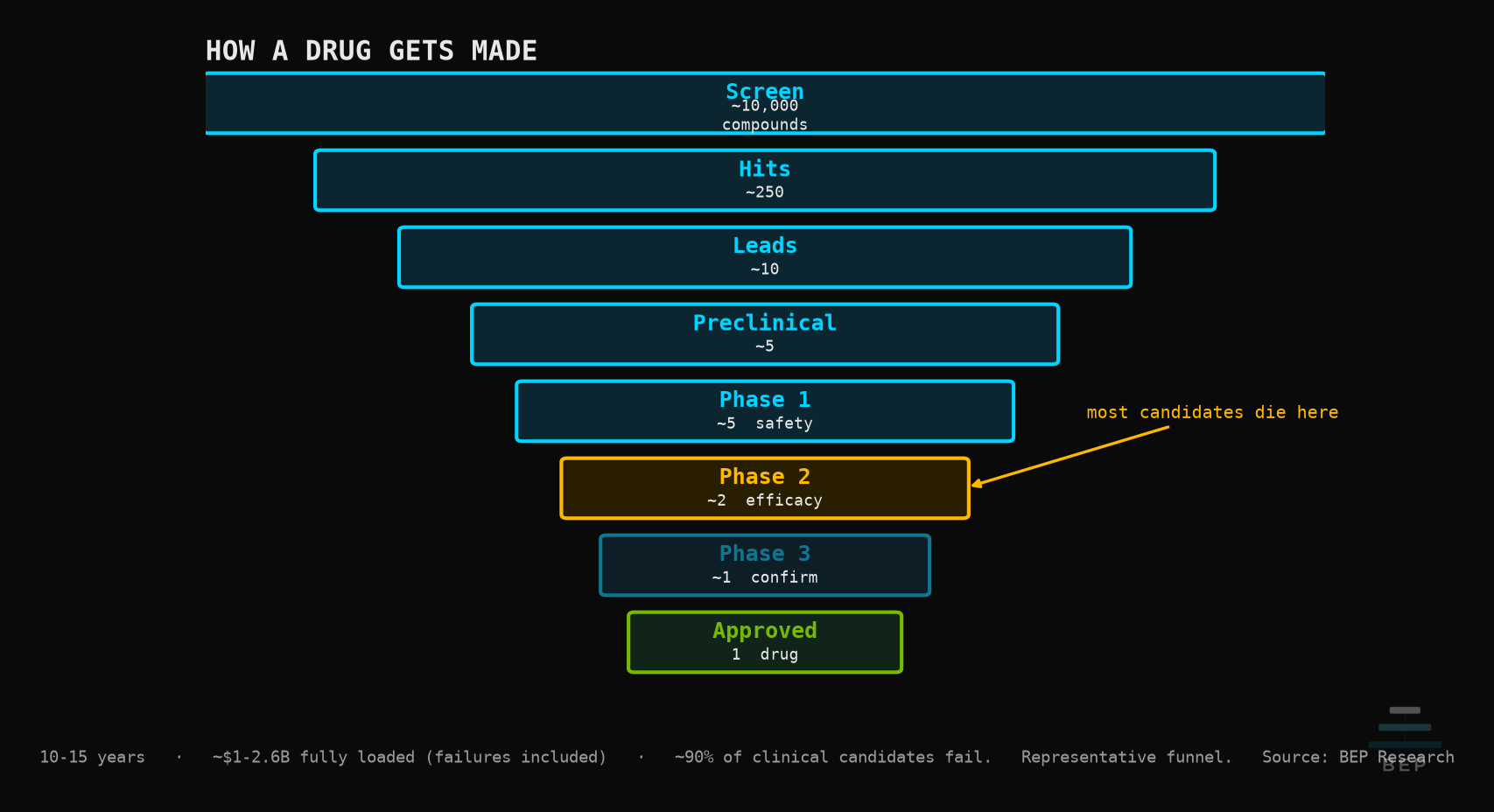
Phase 2 is about efficacy, the first genuine test of whether the drug actually helps patients who have the disease, typically in a group of a few hundred. Phase 2 is the graveyard of the pipeline. This is the stage where a candidate that survived every prior gate, validated target, potent selective molecule, clean animal safety, finally confronts the question that matters, and most often the answer is no. The target turned out not to drive the disease the way everyone believed, or the effect that looked real in mice evaporates in humans. More candidates die in Phase 2 than anywhere else, and they die after the developer has already spent years and a large fraction of the total cost getting them there.
Phase 3 is the large confirmatory trial: hundreds to thousands of patients, sometimes across many countries, designed to prove efficacy and safety rigorously enough to satisfy regulators. Phase 3 trials are the single most expensive component of drug development, and even here candidates fail, a drug that looked promising in a few hundred patients can turn out, in a few thousand, to work no better than existing treatment or to carry a side effect too rare to have shown up earlier.
Only after Phase 3 does a developer file for regulatory approval, in the US, a New Drug Application or Biologics License Application to the FDA, which reviews the entire body of evidence and decides whether the drug can be sold. Approval is not the finish line for the science, but it is the finish line for the gauntlet described in this chapter.
Step Six: The Economics That Make This the Hardest Business in the World
Now assemble the whole chain and look at the numbers, because the numbers are the entire reason this industry is desperate for a better method.
A single approved drug takes, from the start of discovery to approval, on the order of ten to fifteen years. The fully-loaded cost of bringing one drug to market, and "fully-loaded" is the key phrase, is estimated in the range of roughly $1 billion to $2.6 billion. That figure is not the cost of the winning molecule alone. It includes the cost of all the failures. The reason one approved drug costs on the order of a couple of billion dollars is that the company also paid for the nine or more candidates that entered clinical trials and never made it, and for the thousands of molecules that died in the lab before that. Roughly 90% of drugs that enter human trials fail to reach approval. You are not funding a drug; you are funding a portfolio of mostly-doomed attempts, and pricing the survivors to cover the dead.
The cruelest feature of this cost structure is that the failures arrive late. A molecule that dies in Phase 2 or Phase 3 has already absorbed most of its budget before revealing that it doesn't work. In almost any other industry, you find out cheaply and early whether your product is viable. In drug development you often find out expensively and late, after the human trials that are themselves the most costly part of the whole endeavor.
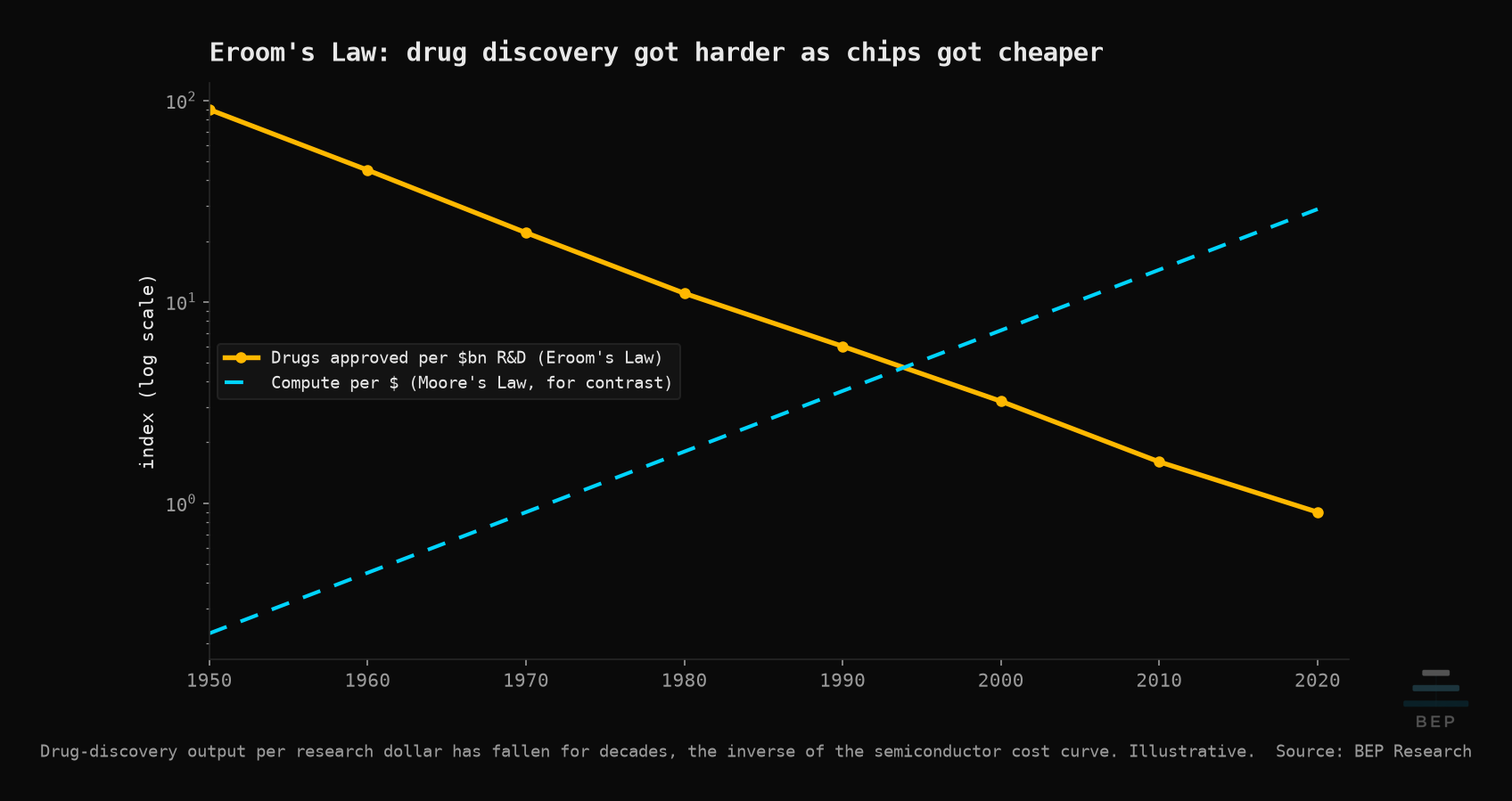
Set against this is one of the most sobering observations in all of technology, and it is worth dwelling on because it is the mirror image of the world BEP Research usually writes about. In semiconductors, the cost of a unit of computing has fallen relentlessly for half a century, Moore's Law, the doubling of transistor density roughly every couple of years, delivering exponential improvement in cost and performance. Drug discovery has done the opposite. The number of new drugs approved per billion dollars of research spending has fallen, steadily, for decades. Someone noticed that this was Moore's Law running in reverse and named it accordingly: Eroom's Law, "Moore" spelled backwards. Where chips get exponentially cheaper, drugs get exponentially more expensive to discover. It is the inverse of the cost curve that has defined modern computing.
Why would productivity fall as the science and tools got better? A few reasons compound:
- Biology is genuinely, irreducibly complex. A chip is something humans designed and therefore understand completely. A human cell is something we are still reverse-engineering, full of feedback loops and interactions no one fully maps. Better tools have not yet closed that gap.
- The failures are late and expensive, as described above, so each failure destroys enormous value and there is no cheap early filter that reliably catches the losers.
- The "better than the Beatles" problem. Every drug approved becomes the standard the next one must beat, and once a good, cheap generic exists for a condition, a new drug for that same condition has to clear a higher bar to justify itself, exactly as a new band today competes against the entire recorded catalog of the Beatles, forever available. The backlog of past successes keeps raising the hurdle for every future candidate.
A Necessary Aside: Not All Drugs Are the Same Kind of Thing
One distinction matters before we close, because different companies specialize in different kinds of drug and the tools that help them differ too. The word "modality" simply means the type of therapeutic molecule.
- Small molecules are the classic drugs: compact chemical compounds, small enough to be swallowed as a pill and to slip inside cells. Most medicines in history are small molecules. They are the world of medicinal chemistry and HTS described above.
- Biologics are large, complex molecules produced by living cells rather than assembled by chemists, most prominently antibodies, which are the immune system's own targeting proteins, engineered to lock onto a chosen target with exquisite precision. Biologics can reach targets small molecules can't, but they are large, generally must be injected rather than swallowed, and are far more expensive to manufacture.
- Newer modalities extend the toolkit further, among them cell and gene therapies that alter or replace the body's own biological instructions, and RNA-based drugs of the kind that powered the recent generation of vaccines. Each opens targets the older modalities couldn't reach, and each brings its own manufacturing and delivery difficulties.
Keep the distinction in the back of your mind. When a later chapter says a given company or AI method works on small molecules but not antibodies, or vice versa, this is the split it is pointing to.
The Question the Rest of This Primer Answers
Step back and look at the shape of everything above. Target identification, hit discovery, lead optimization, preclinical, the clinic, every one of these stages is the same underlying loop repeated at a different scale. You design something: a hypothesis about a target, a molecule, a modification, a trial. You make it: synthesize the compound, run the experiment, dose the patients. You test it: read the assay, the animal study, the trial result. You learn from what came back, and that learning feeds the next design. Design, make, test, learn, around and around, for ten to fifteen years.
Today that loop is run by humans, at the speed of physical laboratory work and the pace of human intuition, and it is slow, expensive, and mostly wrong. A medicinal chemist can imagine and synthesize only so many molecules a year. An experiment takes as long as biology takes. Each turn of the loop costs real time and real money, and Eroom's Law is simply the accumulated verdict on how inefficient the loop has become.
The promise of artificial intelligence in drug discovery is, at its core, a single claim about that loop: that a machine can run the design step vastly faster and cheaper than a human, can help choose which molecules are worth the expensive make-and-test steps, and can learn from each cycle in ways that compress years into months. Whether that promise is real, where in the loop it is already working, where it is still marketing, and which companies are positioned to capture the value if it is real, that is what the rest of this primer sets out to answer. The loop has a name we will use throughout: Design-Make-Test-Learn. Everything that follows is about what happens when you try to run it at the speed of computation instead of the speed of the bench.
© BEP Holdings · Ben Pouladian. Research and commentary, not investment or medical advice.