Part Two · The Stack · Layer 3 of 9
The Test Layer — Why Measurement Is the Moat
Start with the cost of an idea. A generative chemistry model, running on rented GPUs, can propose a billion candidate molecules for roughly the price of the electricity it burns doing so. It can suggest structures that might bind a cancer target, block a viral enzyme, or slot into a receptor like a key into a lock. This is the part of drug discovery that has genuinely become cheap. Proposing is cheap. Imagining is cheap.
Knowing is not. A molecule that a model believes will bind is a hypothesis, nothing more, until someone puts the actual compound in front of the actual protein and watches what happens. Does it bind, and how tightly? Does the protein fold the way the model predicted? Will the molecule cross a cell membrane, survive the liver, avoid poisoning the heart? Every one of those questions is answered the same way it has been answered for a century: by physically measuring a real substance on a real instrument. And those instruments are not software. They are house-priced machines, high-field magnets, mass spectrometers, electron microscopes, built by a handful of companies, most of them decades old, most of them boring, most of them trading at multiples that reflect none of the AI narrative wrapped around drug discovery.
This is the argument of this chapter, and it is the load-bearing wall of the whole primer. The scarce input to a great biology model is not compute and it is not clever architecture. It is measured experimental data at scale. And measured data comes out of exactly one layer of the stack: the instruments that do the measuring. Whoever owns that layer sits astride the one bottleneck the models cannot route around. Anyone can rent the model. Almost no one can replicate the instrument.
What "Measurement" Actually Means in Biology
To see why this layer is defensible, you have to understand what these machines physically do, because the difficulty is the moat. A model can be copied in an afternoon. A superconducting magnet cooled to a few degrees above absolute zero, wound to a field homogeneity of parts per billion, cannot.
Mass spectrometry is the workhorse. The principle is almost crude: take a molecule, give it an electric charge (ionize it), fling it through an electric or magnetic field, and measure how its path bends. Heavier and less-charged particles bend less; lighter and more-charged ones bend more. From that you recover the mass-to-charge ratio, and from a molecule's exact mass you can identify what it is. Chain this together across the tens of thousands of proteins in a cell and you get proteomics, the systematic identification and quantification of every protein in a sample. Genomics tells you what a cell could make; proteomics tells you what it actually made, which is what a drug has to act on.
Not all mass spectrometers are the same, and the differences map directly onto commercial franchises:
- Orbitrap instruments trap ions in an electrostatic field and measure the frequency at which they orbit; that frequency converts to mass with extraordinary resolution. This is the high-resolution workhorse of deep proteomics.
- timsTOF combines "time-of-flight" (literally timing how long an ion takes to fly a fixed distance) with an added dimension called ion mobility, which separates ions by their shape and size, not just their mass. That extra dimension is what makes it fast and sensitive enough to profile the proteome of a single cell, a capability that barely existed five years ago.
- Triple-quadrupole ("triple-quad") instruments are the precision counters. They are less about discovery and more about measuring a known compound to exquisite accuracy, the format that underpins clinical testing and pharmacokinetics.
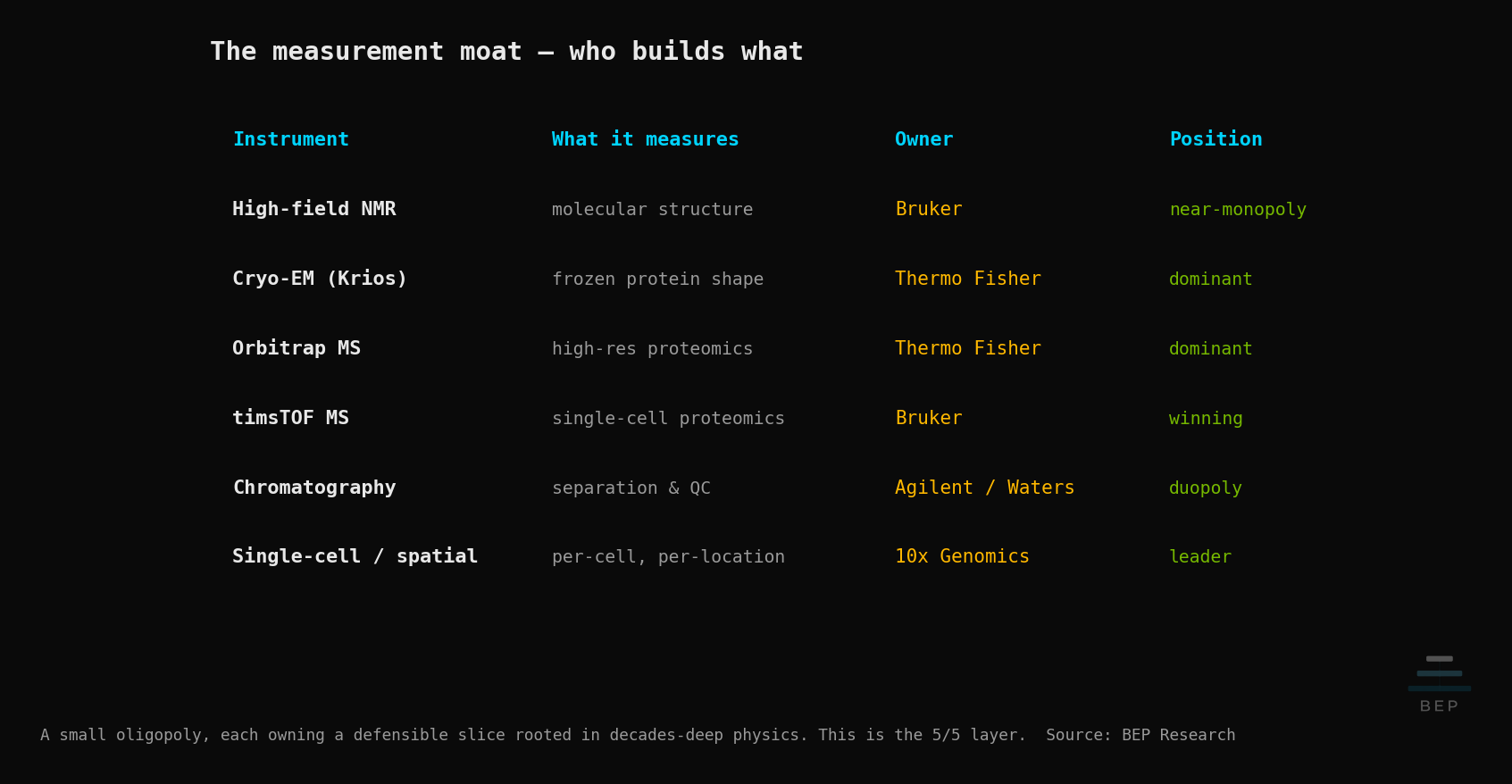
Nuclear magnetic resonance (NMR) attacks structure from a different angle. Certain atomic nuclei behave like tiny magnets; placed in a very strong magnetic field and pinged with radio waves, they resonate at frequencies that depend on their exact chemical neighborhood. Read the pattern back and you can reconstruct how a molecule is put together, atom by atom, in solution. The catch is the magnet. Resolution scales with field strength, and generating a stable, ultra-homogeneous field at the highest strengths requires superconducting magnet technology that only one or two organizations on earth can build. This is not a market share story. It is a near-monopoly rooted in physics and manufacturing know-how that took generations to accumulate.
Cryo-electron microscopy (cryo-EM) is the newest pillar and, for the AI story, the most important. You flash-freeze a protein so fast that water turns glassy rather than crystalline, then fire electrons through it and reconstruct its three-dimensional shape at near-atomic resolution from thousands of noisy images. Cryo-EM is how modern structural biology sees proteins that refuse to crystallize. And here is the connection that most AI-in-biology commentary skips: the structures that AlphaFold and its successors were trained on and are validated against came out of instruments like these. The models are extraordinary interpolators of a ground truth that cryo-EM and X-ray crystallography physically produced. When a model predicts a novel fold, the way you find out whether it is right is by going back to the microscope. The instrument sits both upstream (as training data) and downstream (as validation) of the model. It cannot be designed out of the loop.
Two more categories round out the toolkit. Chromatography, liquid (LC) or gas (GC), is the separation step that comes before almost everything else: you push a mixture through a column packed with material that different molecules stick to for different lengths of time, so they exit one at a time, cleanly enough to be measured. It is the unglamorous plumbing of the lab, and it is everywhere. And a family of cell- and population-level measurements, high-throughput screening assays run across thousands of microplate wells at once, plate readers that quantify the light or fluorescence from each well, flow cytometry (which streams cells single-file past a laser and measures each one), mass cytometry (the same idea but reading metal-tagged markers by mass, for far more parameters per cell), and spatial biology (which measures not just what molecules are present but where they sit inside an intact tissue), turns biology from a bulk average into a per-cell, per-location census.
Every one of these is a physical measurement on a capital instrument. None of them is replaced by a better model. They are what feeds the model.
Bruker: Four Measurement Franchises in One Company
If the thesis is "own the measurement layer," Bruker (BRKR) is the cleanest single expression of it, because it holds not one measurement franchise but four, and they are among the least contested in the entire tool set.
First, high-field NMR. This is the near-monopoly described above. Bruker is the dominant maker of the highest-field research magnets in the world; when a pharma company or a national lab wants the strongest NMR available, there is effectively one Western supplier. That is not a position that erodes quarter to quarter. Second, timsTOF mass spectrometry. Bruker's ion-mobility architecture is the platform that has been winning single-cell and high-throughput proteomics, precisely the frontier where the demand for measured protein data at scale is exploding, and precisely the data a biology model is starved for. Third, spatial biology: through the acquisition of NanoString's assets, Bruker moved into the business of measuring where molecules live inside tissue, one of the fastest-growing measurement modalities. Fourth, the MALDI Biotyper, which uses a specialized mass-spec technique to identify microbial species in clinical microbiology labs, a razor-and-blade installed base that throws off recurring revenue and has little to do with the AI cycle at all.
The point is not that Bruker is a great AI stock. It is that a portfolio built on owning the scarce measurement primitives looks a lot like Bruker: monopoly-adjacent positions in the exact modalities, proteomics, structural work, spatial, that a data-hungry model layer most needs, and a clinical annuity underneath for ballast.
The Rest of the Instrument Oligopoly
The measurement layer is not one company; it is a small oligopoly, and each member owns a defensible slice.
- Thermo Fisher (TMO) is the scale player and, for many labs, the default vendor. It owns the Orbitrap franchise in high-resolution mass spec and the Krios line of cryo-electron microscopes, the machines that produce the very structures AI models are measured against. Add the widest catalog of reagents, consumables, and instruments in the industry, and Thermo is the company hardest to design out of any given workflow simply because it supplies so much of it.
- Danaher (DHR) holds three measurement businesses under one roof: SCIEX in mass spectrometry, Beckman Coulter in flow cytometry, and Leica in microscopy. Danaher's discipline is operational, it buys measurement franchises and compounds their consumable pull-through.
- Agilent (A) is the chromatography and LC/MS specialist, with a growing cell-analysis franchise. Its strength is the analytical workflow and quality-control layer, the measurements that have to be right before a compound advances, and again before it ships.
- Waters (WAT) is the ultra-performance liquid chromatography (UPLC) and tandem-quadrupole MS specialist, concentrated in the regulated, high-precision measurements that pharma manufacturing depends on. Per public reporting, Waters absorbed BD's research flow cytometry business in early 2026, extending it from separations into single-cell measurement.
- Mettler-Toledo (MTD) sits underneath all of it. Precision weighing, titration, and calibration are the substrate every other measurement is referenced against, if the balance is wrong, every downstream number inherits the error. It is the least glamorous and among the stickiest positions in the stack.
- Revvity (RVTY) supplies plate readers and high-throughput screening, the machinery of running assays by the thousand. Bio-Rad (BIO) holds droplet digital PCR, a precise way to count individual nucleic-acid molecules.
Two names matter as the alternative suppliers that keep the monopolies from being absolute. JEOL of Japan is the only real competitor to the Western leaders in both NMR and cryo-EM, the reason those franchises are near-monopolies rather than outright ones. Carl Zeiss (AFX) in microscopy and Oxford Instruments (OXIG) in the cryogenics and superconducting-magnet components that other people's instruments depend on occupy the same critical-supplier tier: not the household names, but the parts of the supply chain a competitor cannot easily route around either.
The Spatial and Single-Cell Frontier
The fastest-growing corner of measurement is the move from bulk to resolved, reading biology one cell and one location at a time. This is where the newest data, and the newest instruments, are being minted.
- 10x Genomics (TXG) pioneered single-cell and spatial transcriptomics, measuring gene expression cell by cell, and increasingly mapping it onto tissue coordinates.
- Akoya and Vizgen (both private) are pure spatial-biology plays, imaging where proteins and RNA sit within intact tissue.
- Standard BioTools (LAB) owns CyTOF mass cytometry, the metal-tagged, mass-read approach to profiling many markers per single cell.
- Quanterix (QTRX) holds Simoa, an ultrasensitive immunoassay platform that can detect proteins at concentrations previously below the noise floor, the measurement of the very faint.
On the flow-cytometry side, Becton Dickinson (BDX) has long been the incumbent (and the seller of the research franchise Waters absorbed), while Cytek (CTKB) pushed the field forward with spectral flow, reading the full emission spectrum rather than a few discrete channels. And the measurement layer is not exclusively Western: China's Mindray (300760) is a large and rising force in clinical analyzers and flow, and Focused Photonics (300203) supplies analytical instrumentation domestically, a reminder that measurement, unlike frontier software, is a physical-manufacturing capability nations invest in building for themselves.
The Data Flywheel: Why the Instrument Beats the Algorithm
Terray makes the case better than any generic example.
Terray is often described as an AI drug-discovery company, and it is one. But its durable edge is not only the chemistry models. It is also a proprietary, ultra-dense microarray that can physically measure billions of small-molecule binding interactions — running vast numbers of miniaturized binding experiments and recording, for each, whether and how well a molecule stuck to a target. That output is not a prediction. It is measured ground truth, generated at a scale no public dataset comes close to: on Terray’s own figures, roughly a billion unique measurements a quarter, more than three times the entirety of public chemistry data every three months. Feed that back into a model and the model improves; run the next models to design and prioritize the following batch of physical experiments and the measurements get more informative; the better data trains a better model again. That loop — measure, learn, measure better — is the data flywheel, and it only spins because Terray owns the measuring apparatus at one end of it. I am an angel investor in Terray, so I have watched this from the inside, and it is the dynamic I described in The 2028 Abundance Report: “AI designed molecules, robots synthesized them, hardware tested them, results fed back into the model.”
Let me put that in plainer terms, because from my seat at Terray it is the thing that stays with me. I have watched that platform both make and physically measure more molecules in a month than a traditional medicinal-chemistry team would get through in a thousand years. Not model them on a screen. Make them and test them against a real target. That is the part that reorders your intuitions. The bottleneck I had always assumed was permanent, the sheer slowness of turning an idea into a measured result, turns out to be an engineering problem, and it is being engineered away in front of me. So when people ask where the real acceleration from AI will show up, my answer is not chat or code. It is here, on the bench. The next great speedup is for the sciences.
I do not say that from a distance. Jacob Berlin walked me through Terray’s Los Angeles lab, and watching the nano-scale hardware run in person is what made the loop concrete: their own-developed, ultra-dense microarray hardware generating that proprietary dataset at a pace that reorders your sense of what is possible, its full-stack AI designing improved molecules in minutes while the automated testing measures the most promising ones, the whole cycle under one roof. And it is aimed at real disease, not a demo. Terray’s lead internal asset is a brain-penetrant small-molecule inhibitor for multiple sclerosis, a place where better therapeutics are desperately needed, alongside a pipeline of de novo medicines for immune-system diseases and partnered programs. That is what owning the measurement layer looks like when it works, an actual drug candidate coming out of a data loop rather than a slide about one.
Strip the example down to its principle. The AI model is the commodity in this system. Foundation models for chemistry and biology are proliferating, open-weighting, and getting cheaper by the month; a competitor can rent equivalent capability. What a competitor cannot rent is the specific, proprietary, physically-measured dataset that comes off an instrument no one else has. Whoever owns the "the hardware tested them" step owns the data that everyone else's model needs, and the more that model layer commoditizes, the more valuable the scarce measured data becomes, not less. Value in this stack flows toward the input that cannot be synthesized.
That reframing is the whole chapter in a sentence: in AI-assisted drug discovery, the moat is not the model, it is the machine that made the data. The proposing has been democratized. The measuring has not, and the physics of superconducting magnets, ion optics, and electron microscopes suggests it will not be for a long time.
Where the Thesis Could Be Wrong
The bear case deserves a fair hearing, because a thesis this clean invites overconfidence. Three risks are real. First, in-silico substitution: if predictive models eventually become accurate enough that fewer physical experiments are needed per approved drug, unit demand for instruments could soften even as biology advances, the models would be eating into the very measurement volume this chapter treats as sacred. The counter is that better models have historically expanded the experimental frontier rather than shrinking it, because they generate more hypotheses worth testing; but "historically" is not "necessarily."
Second, cyclicality and funding: these are capital instruments sold heavily into biopharma R&D budgets, academic grants, and the biotech funding cycle. When that funding contracts, instrument orders are among the first casualties, and several of these names carry premium multiples that assume smooth secular growth. The moat is structural; the revenue is not immune to the cycle. Third, the flywheel is not automatic: owning an instrument that can measure billions of interactions is necessary but not sufficient, the data has to be on targets that matter, at quality high enough to train on, and the company has to actually build the model loop rather than merely possess the hardware. Not every instrument owner converts measurement into a compounding data asset.
What would change the view is straightforward to watch for: a sustained decline in instrument unit volumes that is not explained by the funding cycle, or credible evidence that model predictions are being trusted in place of confirmatory measurement in regulated decisions. Until one of those shows up in the data, the conclusion holds. The scarce input to the intelligence is the measurement, and the measurement comes from this layer.
↗ Explore the Test layer in the interactive map — every company in this layer, public and private, in one view.© BEP Holdings · Ben Pouladian. Research and commentary, not investment or medical advice.