Part Two · The Stack · Layer 2 of 9
The Make Layer: Building What the AI Designed
An AI model can propose a protein, an antibody, a small molecule, or an entire metabolic pathway in an afternoon. None of that is worth anything until someone turns the digital design into physical matter that can be put in a test tube. This is the "make" step of the design-build-test-learn loop, and it is the layer where software optimism collides with the stubborn realities of chemistry. A sequence that a model prints in milliseconds may take a lab three weeks to physically construct, and that three-week gap, repeated across thousands of candidates, is the real speed limit on modern discovery. The companies that own the make layer sell time. Understanding what they actually do requires understanding four distinct manufacturing problems: writing DNA, building small molecules, assembling peptides and proteins, and programming cells.
Writing DNA: The 200-Base Wall
Reading DNA (sequencing) has fallen in cost by a factor of millions since 2003. Writing DNA, synthesizing a chosen sequence from scratch, has not kept pace, and that asymmetry is one of the most important constraints in the entire industry. When a model designs a novel gene, a promoter, or a synthetic pathway, that design has to be physically written base by base.
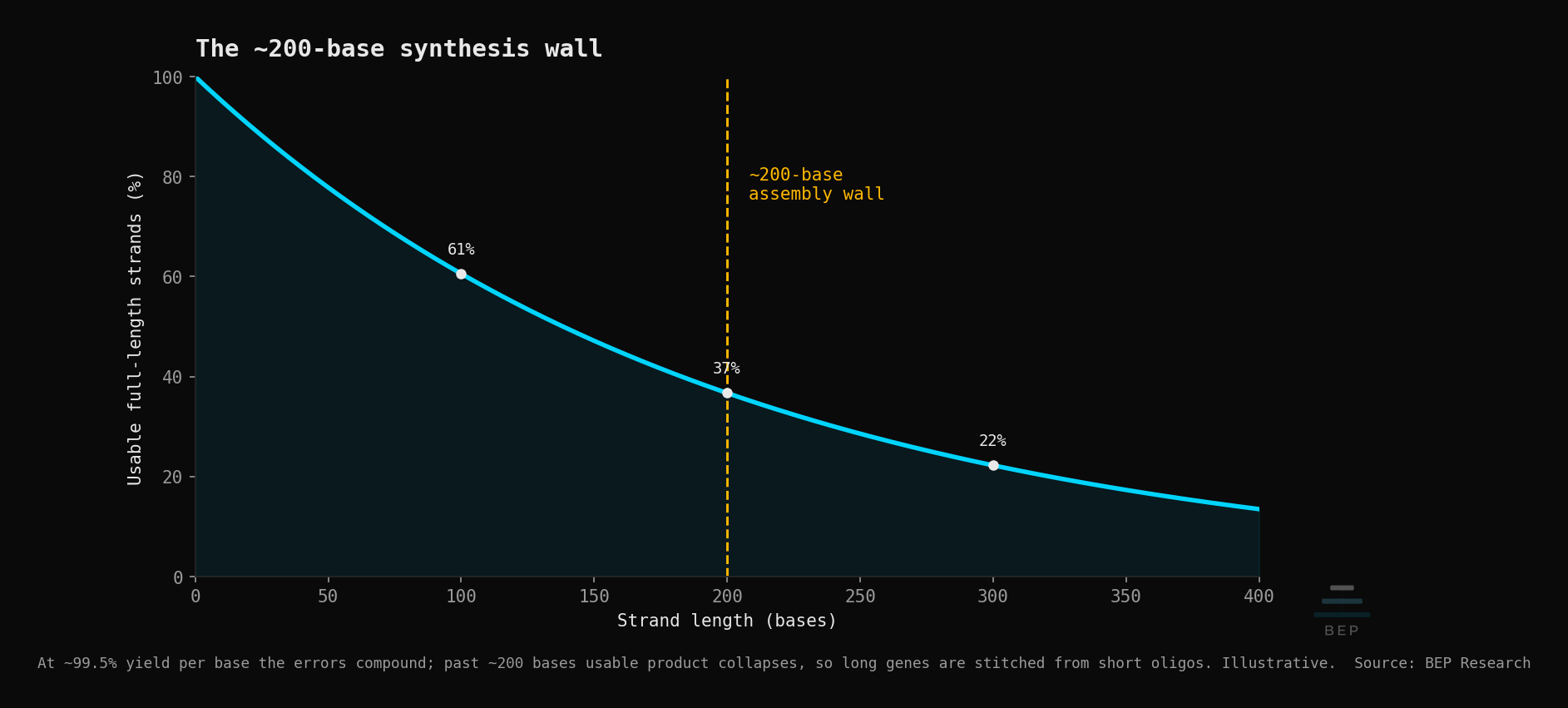
The workhorse chemistry is phosphoramidite synthesis, a four-step cycle that adds one DNA base at a time to a growing strand anchored to a solid surface. Each cycle is highly efficient but not perfect. At roughly 99.5% yield per base, the errors compound: by the time you reach 200 bases, a meaningful fraction of your strands carry at least one mistake, and usable full-length product collapses. That is the practical ceiling people mean when they talk about the ~200-base assembly wall. Genes and pathways are far longer than 200 bases, so the industry works around the wall by synthesizing short, accurate fragments called oligonucleotides (oligos) and then stitching them together enzymatically into genes, and genes into whole constructs. Every additional assembly step adds cost, time, and another opportunity for error.
The three variables that matter here are worth stating plainly because they govern everything downstream:
- Length, how long a fragment you can make before fidelity collapses. Longer fragments mean fewer assembly steps.
- Fidelity, the error rate per base. Higher fidelity means less downstream sequencing and cleanup.
- Turnaround, the wall-clock time from order to usable DNA. This is the variable AI most wants compressed.
The dominant model today is centralized: you order oligos or genes from a vendor and wait days to weeks for shipment. The emerging challenge is enzymatic synthesis, using an engineered enzyme (typically a template-independent polymerase, TdT) to add bases in water-based conditions rather than the harsh solvents of phosphoramidite chemistry. Enzymatic methods promise longer strands, higher fidelity, and, crucially, a machine small and safe enough to sit on a lab bench. That last point is why the phrase "DNA printer" matters. If a researcher can write DNA on-site overnight instead of ordering it and waiting a week, the build step of the discovery loop shrinks from weeks to hours. Compressing the loop is the entire value proposition of AI-assisted discovery, and DNA turnaround is one of its tightest bottlenecks.
Building Small Molecules: Software Plans, Robots Execute
Most approved drugs are still small molecules, compact organic compounds a chemist builds through a sequence of reactions. Historically, deciding how to build a target molecule was an art form. Given a desired structure, a chemist works backward, asking "what simpler pieces could I combine to make this?" and repeats until reaching purchasable starting materials. This is retrosynthesis, and it is now a machine-learning problem: software trained on millions of published reactions proposes viable synthetic routes, ranked by cost, yield, and number of steps.
The second half is execution. Automated organic chemistry platforms take a planned route and run it on robotic hardware, dispensing reagents, controlling temperature, moving product between steps, with far less human intervention than a manual bench. Paired with parallel synthesis, where dozens or hundreds of variants are made simultaneously in plates, this lets a team physically test the space of molecules an AI proposes rather than hand-picking a handful to make. The constraint that never goes away is purification: making the molecule is often easier than isolating it cleanly from the reaction mixture, and purification remains stubbornly manual and slow. Any honest read of automated chemistry treats purification as the gating step, not the reactions themselves.
Peptides and the GLP-1 Boom
Peptides, short chains of amino acids, sit between small molecules and full proteins in size, and they have become one of the most commercially important molecule classes in medicine. The reason is the GLP-1 class of metabolic drugs (the mechanism behind semaglutide and tirzepatide), which turned peptide manufacturing from a niche into a capacity-constrained industry almost overnight. When a single drug class drives tens of billions in revenue, the machines that make peptides become strategically valuable.
The core method is solid-phase peptide synthesis (SPPS), invented by Bruce Merrifield in the 1960s: the peptide is built one amino acid at a time on an insoluble resin bead, with reagents washed through and drained away between each addition. Like DNA synthesis, it is a cyclic add-and-wash process, and like DNA synthesis, yield-per-cycle sets a practical length limit, longer peptides are harder and more expensive to make cleanly. The commercial edge in this hardware is speed and purity per cycle, which is why microwave-accelerated and flow-based SPPS instruments command premium pricing in a market that is currently starved for peptide capacity.
Cell-Free Protein Synthesis
Proteins are the actual drugs in much of biologics, antibodies, enzymes, engineered binders. The traditional way to make a protein is to insert its gene into living cells (bacterial or mammalian), grow them, and harvest what they produce. This works but is slow: you spend days engineering and growing the cells before you get any protein, and the cell's own biology limits what you can make.
Cell-free protein synthesis extracts the molecular machinery of protein production, the ribosomes, transfer RNAs, and energy systems, and runs it in a tube without any living cells. You add DNA encoding your protein and get protein out in hours rather than days. Two properties make this powerful for AI-driven discovery. First, speed: the make step collapses, which suits a workflow generating many candidates. Second, it can incorporate unnatural amino acids that living cells cannot tolerate, opening chemistry a cell-based system simply cannot reach, the basis for precisely engineered antibody-drug conjugates. The tradeoff is scale and cost economics that have historically favored living cells for large-volume manufacturing.
Biofoundries: Programming Cells as a Service
The most ambitious version of the make layer treats the cell itself as the product. A biofoundry is a highly automated facility that designs, builds, and tests engineered organisms at industrial throughput, write the DNA, insert it into a host cell, grow thousands of variants in parallel, measure which ones perform, and feed the results back into the next design round. The promise is "program cells as a service": tell the foundry what you want a microbe to produce, and the automation iterates toward a strain that does it. This is where the design-build-test-learn loop becomes fully mechanized, and where the AI models of the design layer have the most physical infrastructure to plug into.
The Companies, and Which Ones Last
Twist Bioscience (TWST) is the volume leader in written DNA. Its defining innovation was moving phosphoramidite synthesis onto a silicon chip, miniaturizing the reaction so that where a conventional plate makes 96 oligos, Twist's chip makes thousands in the same footprint, a manufacturing-cost advantage that let it undercut incumbents and scale. Twist sells synthetic genes, oligo pools, and increasingly antibody libraries and NGS tools. It is the closest thing the make layer has to a picks-and-shovels franchise for DNA.
Integrated DNA Technologies, now inside Danaher (DHR), is the oligo workhorse, the vendor a very large share of labs actually order their custom oligos, primers, and CRISPR guide RNAs from. Sitting within Danaher gives IDT the balance sheet and life-sciences distribution of one of the industry's most disciplined operators. For an investor, IDT is not a standalone bet but a reason DHR has quiet, recurring exposure to the consumable that every molecular biology experiment burns through.
The enzymatic-DNA challengers are mostly private and are attacking the turnaround and length constraints directly. DNA Script commercialized a benchtop enzymatic synthesizer (the SYNTAX system), the "DNA printer" that puts overnight, on-site DNA writing in a lab. Ansa Biotechnologies has demonstrated enzymatic synthesis of unusually long single oligos, pushing directly at the fidelity-limited length wall. Molecular Assemblies pursues enzymatic long-read synthesis for gene and cell therapy applications, and Evonetix takes a different hardware path with a MEMS chip that controls synthesis with thermal precision at thousands of independent sites. Each is a bet that whoever breaks the 200-base wall economically resets the cost curve of written DNA.
GenScript (1548.HK) is the vertically integrated Chinese player, offering genes, oligos, peptides, proteins, and antibody services across one platform at aggressive pricing, a genuinely broad make-layer supplier. The investment caveat is regulatory: GenScript and its affiliates have been named in the context of the proposed U.S. BIOSECURE Act, legislation aimed at restricting federally connected customers from working with certain Chinese biotech providers. That exposure is a real, non-trivial overhang for any Western institutional buyer, and it is arguably a tailwind for the Western suppliers that would absorb displaced demand.
Telesis Bio is the cautionary tale to keep in view. It built genuinely advanced automated DNA-writing hardware (the BioXp benchtop system, out of the Craig Venter lineage) and still could not sustain a public listing, it fell below Nasdaq's minimum equity and public-float requirements and voluntarily delisted to the OTC market in 2024. The lesson is not that the technology failed; it is that impressive hardware without a durable, high-margin recurring revenue stream does not survive as a public company.
In automated chemistry, both leaders are private. Chemify commercializes the "Chemputer" concept, a system that reads a synthesis route in a standardized chemical programming language and executes it on hardware, tightening the loop from retrosynthesis software to physical molecule. Chemspeed is the established supplier of automated and parallel synthesis workstations that many labs already run. The read here is that the chemistry make layer is being automated by tooling vendors, not by a single public pure-play.
On peptides, the hardware names are more accessible. CEM pioneered microwave-accelerated SPPS, a speed-and-purity edge that matters intensely in a capacity-starved peptide market. Gyros Protein Technologies, part of Mesa Laboratories (MLAB), supplies automated peptide synthesizers, giving MLAB a small but real position in the GLP-1-adjacent tooling story. Biotage, taken private by KKR, rounds out the purification-and-synthesis workflow, a reminder that the peptide boom is drawing serious financial-sponsor capital into the picks and shovels.
In cell-free, Sutro Biopharma (STRO) is the most investable name, but note carefully what it is: Sutro uses its cell-free platform (XpressCF) to build its own antibody-drug conjugate pipeline rather than selling synthesis as a service. It is a drug developer whose edge is a make-layer technology, which means it is valued on clinical outcomes, not consumable throughput. Nuclera sells a benchtop system for rapid protein production on demand, and Tierra Biosciences offers cell-free protein synthesis as a service to speed the design-build-test loop for other labs.
In the biofoundry category, Ginkgo Bioworks (DNA) is the largest public bet on programming cells as a service, having built enormous automated foundry capacity. Its history is also a warning about the gap between platform capacity and platform economics. Culture Biosciences, private, offers cloud-based bioreactors that let teams run and monitor fermentation experiments remotely, automating the "grow and measure" half of the strain-engineering loop.
The Investment Read: Sell the Blades or Die
The make layer is where the graveyard is. Amyris, a pioneering synthetic-biology company, filed for bankruptcy. Zymergen, once a high-profile biofoundry IPO, collapsed and was absorbed into Ginkgo. Telesis delisted. The pattern is consistent and it is the single most important thing an investor should take from this chapter: a make-layer platform that cannot attach itself to a recurring consumable or a marketable product does not survive, no matter how good the science looks in a demo. Elegant hardware is not a business. A razor without blades is a liability with a depreciation schedule.
This is precisely why Twist and IDT endure while flashier platforms fail. They sell the blades. Every synthetic gene, every custom oligo, every CRISPR guide is a consumable that gets used up and reordered, and as AI-driven design generates more candidates, it generates more orders for the DNA that turns those candidates into matter. The demand curve for written DNA is, structurally, the exhaust of the entire AI-discovery engine. Twist's fiscal third quarter, reported August 3, 2026, is the first clean measurement of that exhaust. DNA synthesis and protein solutions revenue came in at $56.6M, up 39% year over year, with the therapeutics piece inside it up 49% to $40.4M and 369,000 genes shipped in a single quarter. Management raised full-year guidance, guided to adjusted EBITDA breakeven in the fourth quarter, and told investors that orders tied to AI-enabled drug discovery are on track for triple-digit growth in both fiscal 2026 and fiscal 2027, with CEO Emily Leproust describing the segment maturing into “a durable growth engine.” That is the thesis of this layer showing up in someone's revenue line: models designed more candidates, and somebody had to physically write the DNA.
The same disclosure quantifies the turnaround argument made above, which matters more than the revenue line for anyone trying to judge whether the loop is actually compressing. Measured on a constant basis (roughly one million oligos at femtomole scale), Twist reports cutting turnaround time from 26 hours in the first half of 2023 to 7 hours by its second quarter of fiscal 2026, a ~73% reduction, alongside a ~60% reduction in cost per unit, a ~70% reduction in chemical waste, and roughly 4x the writing capacity out of the same platform. Those are not market-share numbers; they are the physics of the make step getting faster inside one vendor's installed base. Recall that turnaround, not raw cost, is the variable AI most wants compressed, because it sets how many times a discovery team can go around the design-make-test-learn loop in a quarter. A four-fold capacity increase and a turnaround measured in hours rather than days is what “the loop is speeding up” looks like when you put a number on it. Twist also publishes the loop itself in its investor materials, showing which steps it owns (DNA synthesis, protein expression, characterization) and noting that each turn of the cycle drives repeat orders, which is the toll-on-activity argument stated by the company collecting the toll. The enzymatic challengers are worth watching not because a benchtop printer is inherently a better business, but because if one of them genuinely breaks the length-fidelity-turnaround constraint and pairs it with a proprietary consumable (the reagent cartridge, the enzyme, the chip), it inherits the same recurring economics that keep Twist and IDT alive. Absent that recurring attachment, the make layer remains the most seductive and most dangerous place to put capital in the entire drug-discovery stack, the place where the science is most visibly real and the business model most quietly fatal.
↗ Explore the Make layer in the interactive map — every company in this layer, public and private, in one view.© BEP Holdings · Ben Pouladian. Research and commentary, not investment or medical advice.