Part Two · The Stack · Layer 1 of 9
The Design Layer — Teaching a Computer to Invent a Molecule
Every drug is a small physical object that has to fit against a much larger physical object. The large object is usually a protein, a folded chain of amino acids that the body uses to do work, whether that is carrying oxygen, copying DNA, or relaying a signal that tells a cell to grow. Disease often means one of these proteins is doing too much, too little, or the wrong thing. A drug works by binding to that protein and changing its behavior: blocking it, stabilizing it, or flagging it for destruction. The entire design problem reduces to one question. What molecule will lock onto this specific target, in the right spot, tightly enough to matter and selectively enough not to hit everything else?
For most of pharmaceutical history that question was answered by making molecules in a lab and testing them one at a time. The design layer is the attempt to answer it inside a computer first, to narrow millions of candidates down to a few dozen worth synthesizing before anyone touches a pipette. This is the part of the drug-discovery pipeline where the recent AI advances have been most visible, most celebrated, and, as we will argue, least defensible as a business.
Why 3D Shape Is the Whole Game
A protein is manufactured as a flat string of amino acids, twenty possible letters in a specific order encoded by a gene. But it does not stay flat. The chain folds spontaneously into a precise three-dimensional shape, and that shape is what determines function. A drug has to fit the folded surface, the pockets, grooves, and crevices of the real object, not the string that describes it. For fifty years, reading the string was cheap and getting the folded shape was expensive, requiring techniques like X-ray crystallography that could take a graduate student a year to resolve a single structure.
This gap, sequence known, structure unknown, was called the protein-folding problem, and it stood open for half a century. In 2020, Google DeepMind's AlphaFold2 effectively closed it, predicting 3D structure directly from amino-acid sequence at an accuracy that rivaled physical experiments. DeepMind then released predicted structures for essentially every protein known to science, hundreds of millions of them, into a public database. Work that took a year could now be done in minutes on a laptop. The 2024 Nobel Prize in Chemistry recognized this: half to Demis Hassabis and John Jumper of DeepMind for AlphaFold, and half to David Baker of the University of Washington for computational protein design, the inverse problem of building new proteins from scratch. It was, in effect, a Nobel for teaching computers the geometry of life.
Structure matters for drug design because you cannot rationally design a key without seeing the lock. Once you can predict a target's shape, you can start asking which molecules will fit it, and you can do that computationally, in bulk, before committing lab time and money.
From Shape to Binding: Docking and Physics
Knowing the shape of the lock is not the same as knowing which key turns it. That is the binding problem, and it comes in tiers of increasing rigor and cost.
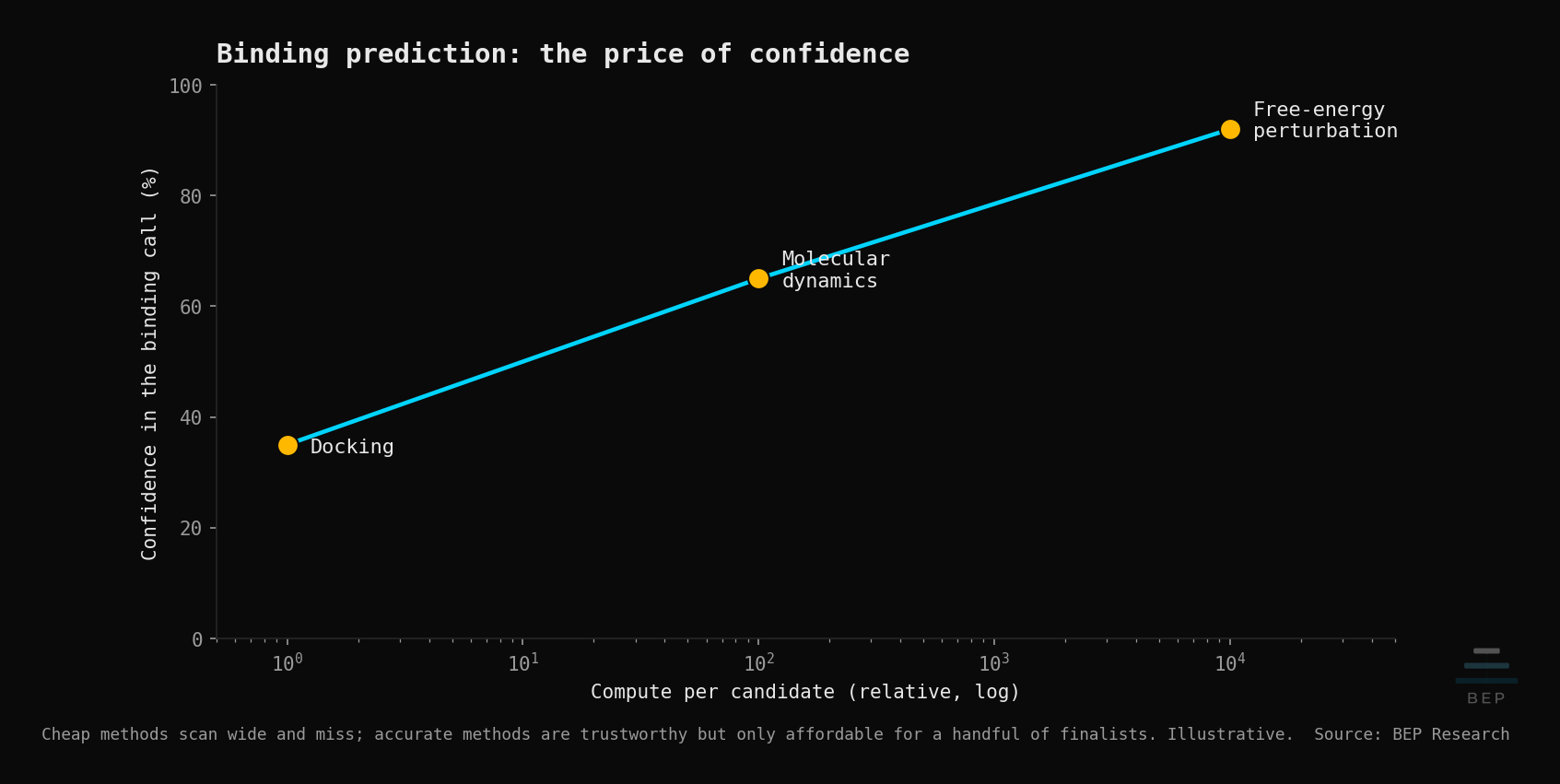
- Docking is the fast, cheap first pass. The software takes a candidate molecule and computationally tries to fit it into the target's pocket in millions of orientations, scoring each for how snugly it sits. It is a rough geometric filter, good for triaging a huge library down to plausible candidates, unreliable as a final verdict.
- Molecular dynamics (MD) is a physics simulation. It models every atom and the forces between them and lets the whole system move over time, the way it actually would in the watery environment of a cell. This captures the fact that proteins are not rigid statues; they wiggle, breathe, and flex, and a pocket that looks closed in a static picture may open under motion.
- Free-energy perturbation (FEP) is the high-accuracy tier. It uses MD-style physics to predict, with genuine quantitative precision, how much more tightly one candidate binds than another. FEP can tell a chemist that adding a single fluorine atom in a particular spot will improve binding by a specific amount, the difference between a guess and a measurement. It is computationally brutal, which is exactly why it runs on GPU clusters rather than desktops.
The strategic point is that binding prediction sits on a compute-versus-confidence curve. Cheap methods scan wide and miss; expensive methods are trustworthy but only affordable for a handful of finalists. The commercial value concentrates where a company can push accuracy up without letting cost run away, and that is a software-and-hardware problem, not a magic one.
Generative Chemistry and De Novo Protein Design
Everything above evaluates molecules that already exist. The newer and more radical capability is inventing ones that do not.
Generative models, the same broad family of technology behind image generators, can be pointed at a protein pocket and asked to hallucinate a molecule shaped to fill it. Diffusion models, which learn to turn random noise into structured output, have proved especially good at this. The lineage that traces back to David Baker's lab, notably RFdiffusion, can design entirely new proteins to order: give it a target surface and it generates a novel protein that binds there, a protein that has never existed in any organism. Profluent used models in this vein to produce OpenCRISPR-1, a functional gene-editing enzyme designed by AI rather than borrowed from bacteria.
A parallel idea is the protein language model. Proteins can be treated like sentences in a language whose grammar evolution wrote over billions of years. Train a large model on hundreds of millions of natural protein sequences and it learns which arrangements are viable and which are nonsense, the same way a language model learns that some word sequences are fluent and others are gibberish. EvolutionaryScale's ESM3 is the leading public example, a model reasoning jointly over a protein's sequence, structure, and function; it can generate proteins with desired properties by, in effect, writing in the language of biology. Chai Discovery (Chai-1, Chai-2), Latent Labs, and others are building in adjacent territory. The upshot: design has moved from screening what nature already made to authoring what it never got around to.
The furthest expression of this to date arrived on August 6, 2026, when a Stanford and Arc Institute team reported that a generative model called Evo had designed complete viral genomes from scratch, the first whole genomes authored by an AI rather than derived from a natural template. The result is worth reading carefully in both directions. On the capability side, it is remarkable: the functional designs carried between 67 and 392 novel mutations, and by some taxonomic standards one of them would qualify as a new species. On the investment side, the number that matters is the yield. The team physically synthesized 285 candidate genomes and sixteen were viable, a hit rate near six percent, and there was no way to identify those sixteen except to build all 285 as real DNA and test them. That is this primer's argument stated as an experiment: generation is cheap and abundant, selection is physical and scarce, and the 285 syntheses and assays required to find the sixteen are precisely the recurring demand the make and test layers sell into.
Two clarifications, because coverage of this result has been loose. The work was led by Brian Hie at Stanford and published in Science, using the Evo models trained on the genomes of roughly two million bacteriophages. These are phages, which infect bacteria rather than people; the ones built here showed restricted tropism to a non-pathogenic laboratory strain of E. coli. And the genetic code of viruses capable of infecting humans, animals, or plants was deliberately excluded from training, so the model cannot generate a human pathogen. The demonstrated application is therapeutic rather than adversarial: the AI-designed phage cocktail cleared E. coli that natural bacteriophages could no longer kill, with near-term targets named as Pseudomonas aeruginosa and the plant pathogen Xanthomonas campestris. Antibiotic resistance is one of the few therapeutic problems as economically ugly as the ones described in Part One, and this is the first credible case of a model designing that class of medicine end to end.
The biosecurity discussion around the paper deserves attention, and it lands somewhere useful for this primer's argument. Writing alongside the result, Tom Inglesby and Moritz Hanke of the Johns Hopkins Center for Health Security warned that the capability to compose viral genomes with generative AI now exists while “the governance to safely steer it does not.” Tom Ellis of Imperial College London supplied the deflating counterweight, noting this is the smallest and easiest genome anyone could attempt and that the AI-design threat is modest next to the far simpler route of modifying pathogens that already exist. Most relevant here, Filippa Lentzos of King's College London argued that regulation should not focus solely on the model, and that a layered approach runs through model access, research review, laboratory biosafety, and critically synthesis screening at the point DNA is physically manufactured. That is a governance conclusion arriving at the same place this primer arrives at commercially: the enforceable chokepoint in biology is not the software that proposes a sequence, it is the physical infrastructure that writes and measures it. The layer that can be controlled is the layer that is scarce, and the layer that is scarce is the layer with pricing power.
Will It Survive Contact With the Body? ADMET In Silico
A molecule that binds beautifully is still worthless if it poisons the liver, gets flushed out in an hour, or never reaches the target tissue. These properties travel under the acronym ADMET, absorption, distribution, metabolism, excretion, and toxicity, and they are where most drug candidates quietly die, often late and expensively.
In-silico ADMET prediction tries to flag those failures early by estimating a molecule's behavior in the body from its structure alone. Related to this is PBPK modeling, physiologically based pharmacokinetics, which simulates how a compound moves through and concentrates in different organs over time. Done well, this shifts a fatal discovery from Phase I in humans to a Monday-morning calculation. It is unglamorous and it is one of the highest-leverage places computation touches the pipeline, because the cost of a failure caught here versus in the clinic differs by orders of magnitude.
The Substrate Underneath Everything
None of this runs on air. Structure prediction, MD, FEP, and generative models are all enormous matrix-multiplication workloads, which is precisely the arithmetic that graphics processing units were built to do fast and in parallel. Underneath the entire design layer sits a stack of GPUs, the software frameworks that train and serve the models, and the cloud infrastructure that rents the whole thing by the hour. This substrate is the same one powering the rest of the AI economy, and that shared foundation is the key to reading the investment case, because it means the people selling shovels here are also selling shovels to every other gold rush at once.
The Names You Can Actually Own
NVIDIA (NVDA) is the toll under all of it. Its GPUs run the training and inference for essentially every model named in this chapter, whoever built them. Beyond raw silicon, NVIDIA supplies domain software: BioNeMo, a platform for training and serving biology models (including hosted versions of structure and generative models); Parabricks, which accelerates genomic analysis; and the broader Clara healthcare stack. NVIDIA's position is deliberately neutral, it does not need to pick the winning model or the winning drug company, because it collects on every attempt. When Schrödinger runs FEP, when a startup trains a protein language model, when a pharma rents cloud GPUs for docking, the compute meter runs through NVIDIA hardware. That is the most durable seat at this table, and it is durable precisely because it is agnostic.
Alphabet (GOOGL) owns the most celebrated science in the field. DeepMind produced AlphaFold and its successor AlphaFold 3, which extends prediction from proteins alone to how proteins interact with drugs, DNA, and other molecules, closer to the actual binding question. Alphabet also monetizes the substrate through Google Cloud. The catch, from an investor's standpoint, is that drug discovery is a rounding error inside a company this size, and its most important contribution, AlphaFold's structures, was given away for free, which tells you something about where the defensible value does not sit. In July 2026 Alphabet made that judgment explicit: DeepMind disbanded the standalone AlphaFold team, moving people onto Gemini and into Isomorphic Labs, after John Jumper, who shared the Nobel for the work, had already left for Anthropic in June. Less than two years after the highest honor in science, the team behind the most celebrated model in computational biology was worth more to its owner dispersed into a general-purpose model and a drug pipeline than kept together as a science-model shop. If you want one piece of evidence for the claim that the model layer commoditizes and the value migrates to the loop, that is it, and it comes from the company with the best model in the field.
Microsoft (MSFT) and Amazon (AMZN) are the rails. Azure AI and AWS (including HealthOmics, purpose-built for genomic and biological data) rent the compute, storage, and managed model-serving that discovery teams run on when they do not own their own clusters. Like NVIDIA, they profit from activity rather than outcomes, a cloud bill is owed whether the drug works or not.
Schrödinger (SDGR) is the most established pure-play in physics-based design. Its FEP-plus-machine-learning software has been licensed across large pharma for years, giving it real, revenue-generating adoption and a technical reputation predating the AI wave. Schrödinger also runs its own drug pipeline and takes equity stakes in partner programs, trying to convert a tools business into upside on the drugs those tools help design. That dual model is the tell: selling software alone, even excellent software, has proven a hard way to capture the value the software creates.
Certara (CERT) operates one layer over, in model-informed drug development and biosimulation, using models to inform dosing, trial design, and regulatory submissions, sometimes described as running "in-silico trials." Its moat is less algorithmic novelty than accumulated regulatory credibility: the FDA and its global peers already accept Certara's simulations as part of drug filings, and that acceptance is slow to earn and slow to displace.
The frontier model labs are where the newest science lives and where public investors mostly cannot buy in. EvolutionaryScale built ESM3, then saw its team absorbed into the Chan Zuckerberg Initiative's Biohub in 2025, the model diffused, the company effectively did not survive as an independent going concern. Profluent (OpenCRISPR-1), Chai Discovery (Chai-1, Chai-2), and Latent Labs are private. Basecamp Research is pursuing a different edge, proprietary training data drawn from sampling global biodiversity, on the thesis that unique data, not the model architecture, is what is actually scarce. In China, BioMap's xTrimo is a large-scale biological foundation model. The common thread: the frontier is private, fast-moving, and repeatedly demonstrating that a model, once built, does not stay proprietary for long.
The Investment Read on the Design Layer
Design is indispensable and, as a place to capture durable value, the weakest link in the chain. The reasons are structural. Models diffuse, AlphaFold's structures are free, ESM's weights are broadly available, and academic labs reproduce frontier results within a year or two of publication. Compute is rentable by anyone with a credit card, which means no design shop can fence off the substrate. And the most advanced work keeps happening inside private labs or getting absorbed into non-commercial homes before public shareholders can participate.
What survives that diffusion is not the cleverest model but the position everyone has to pay through regardless of which model wins. That points to the toll, NVIDIA above all, with the hyperscale clouds behind it, over the toolmakers. Among the tool companies, the ones worth watching are those bolting on something the software alone cannot be copied into: Schrödinger's owned pipeline, Certara's regulatory standing, proprietary-data plays like Basecamp. The pure algorithm, however brilliant, is the part of this business most likely to become a commodity. In a gold rush where the maps are free and the picks are rented, the durable business is the one that owns the road.
↗ Explore the Design layer in the interactive map — every company in this layer, public and private, in one view.© BEP Holdings · Ben Pouladian. Research and commentary, not investment or medical advice.