Part One · How the Lab Works
Why Now: The Inflection Is Real, and It Is Dated
Primers should be honest about timing, because “eventually” is not a thesis. Four things happened between 2024 and 2026 that turned AI-for-science from a promise into a capital event.
The Nobel. The 2024 Chemistry Nobel went to the people who built AlphaFold and modern computational protein design. That is the field certifying that the science works, which is the signal capital waits for before it commits at scale.
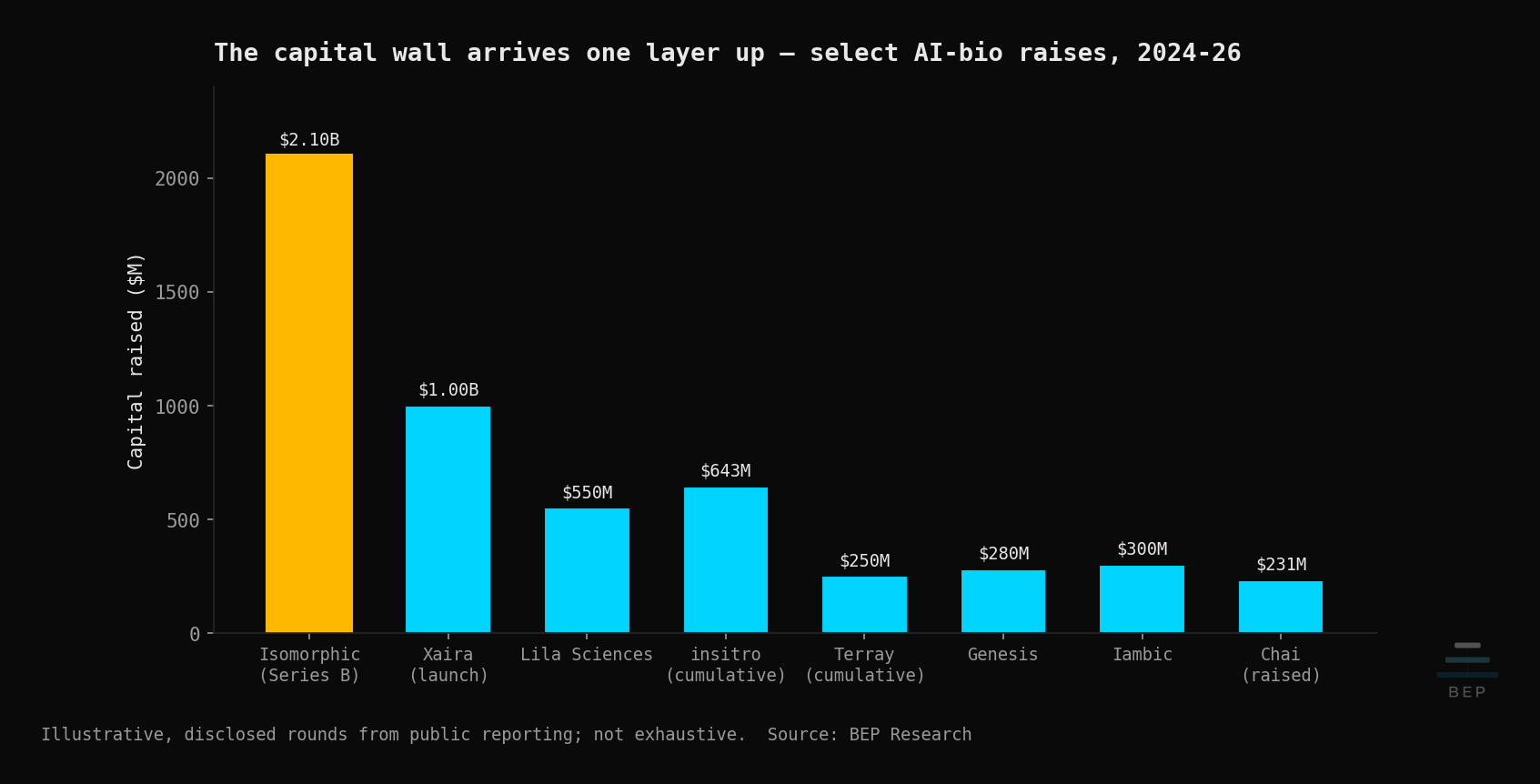
The money. And it came. Per public reporting, Isomorphic Labs raised a $2.1B round; Xaira launched with roughly a billion dollars, the largest seed the sector has seen; Lila Sciences raised $550M to build “AI science factories”; and Terray, insitro, Genesis, Iambic, and Chai each raised nine figures. This is the same wall of capital that hit AI infrastructure in 2023, arriving one layer up the value chain.
The models crossed a threshold. Structure and interaction prediction went from research curiosity to daily tool. Protein language models are now designing functional proteins that work in the wet lab, most visibly Profluent's OpenCRISPR-1, an AI-designed gene editor, and the enzymes generated by EvolutionaryScale's ESM3. The generative step stopped being the joke and became the easy part, which is exactly why the bottleneck moved downstream.
The substrate got built. NVIDIA laid the compute-and-model rails under the whole field: BioNeMo for model training and serving, Clara and Parabricks for imaging and genomics, plus a billion-dollar co-innovation lab with Eli Lilly and NVentures checks into the leading privates. It is selling the picks to the biologists now, the same way it sold them to the language labs.
And this summer, the frontier labs themselves arrived. The clearest sign an inflection is real is who starts spending to own it. In June 2026 NVIDIA shipped its BioNeMo Agent Toolkit at the BIO convention, turning large language models into agents that call the field’s proven tools, protein folding, molecular docking, generative chemistry, on demand. OpenAI released LifeSci-Bench, a benchmark for how well models handle real life-science tasks. And Anthropic, the maker of Claude (the model I used to help assemble this primer), bought Coefficient Bio, a small team of ex-Genentech researchers, in a roughly $400 million deal, its largest acquisition to date, then laid out its own drug-development ambitions in public, most concretely by shipping Claude Science on June 30, an “AI workbench for scientists” with sixty-plus built-in skills for genomics, proteomics, and structural biology, and integrations into NVIDIA’s BioNeMo toolkit. The revealing part is the deployment: Claude Science runs on the lab’s own infrastructure, so the sensitive data never leaves the building, the model company conceding in a product decision that the data is the one input it cannot have. NVIDIA, OpenAI, and Anthropic all moved into biology within a few weeks of each other; you do not get that kind of clustering at the start of a hype cycle, you get it when the people with the best information think the window is now.
And in August 2026 the people moved, which is the least reversible signal of the set. On August 5, Jeff Dean left Google after twenty-seven years to co-found Discovery Loop, a public-benefit corporation whose stated purpose is to automate complex, multi-step science and engineering experiments end to end, with Oriol Vinyals, Quoc Le, and Sanjay Ghemawat as co-founders and Google itself as founding investor, cloud partner, and supplier of its first year of compute. Its roadmap starts with machine-learning research and extends into hardware design, drug discovery, and clean energy. The same day, Demis Hassabis handed off day-to-day leadership of Google DeepMind to Koray Kavukcuoglu, took the chair of DeepMind and the chief-scientist role at Alphabet, and said he would lean further into Isomorphic Labs to work on curing disease. Alphabet fell roughly 5% on the reshuffle. And a week before that, DeepMind had disbanded the AlphaFold team outright, scattering it into Gemini and Isomorphic, after Nobel co-laureate John Jumper had already left for Anthropic in June.
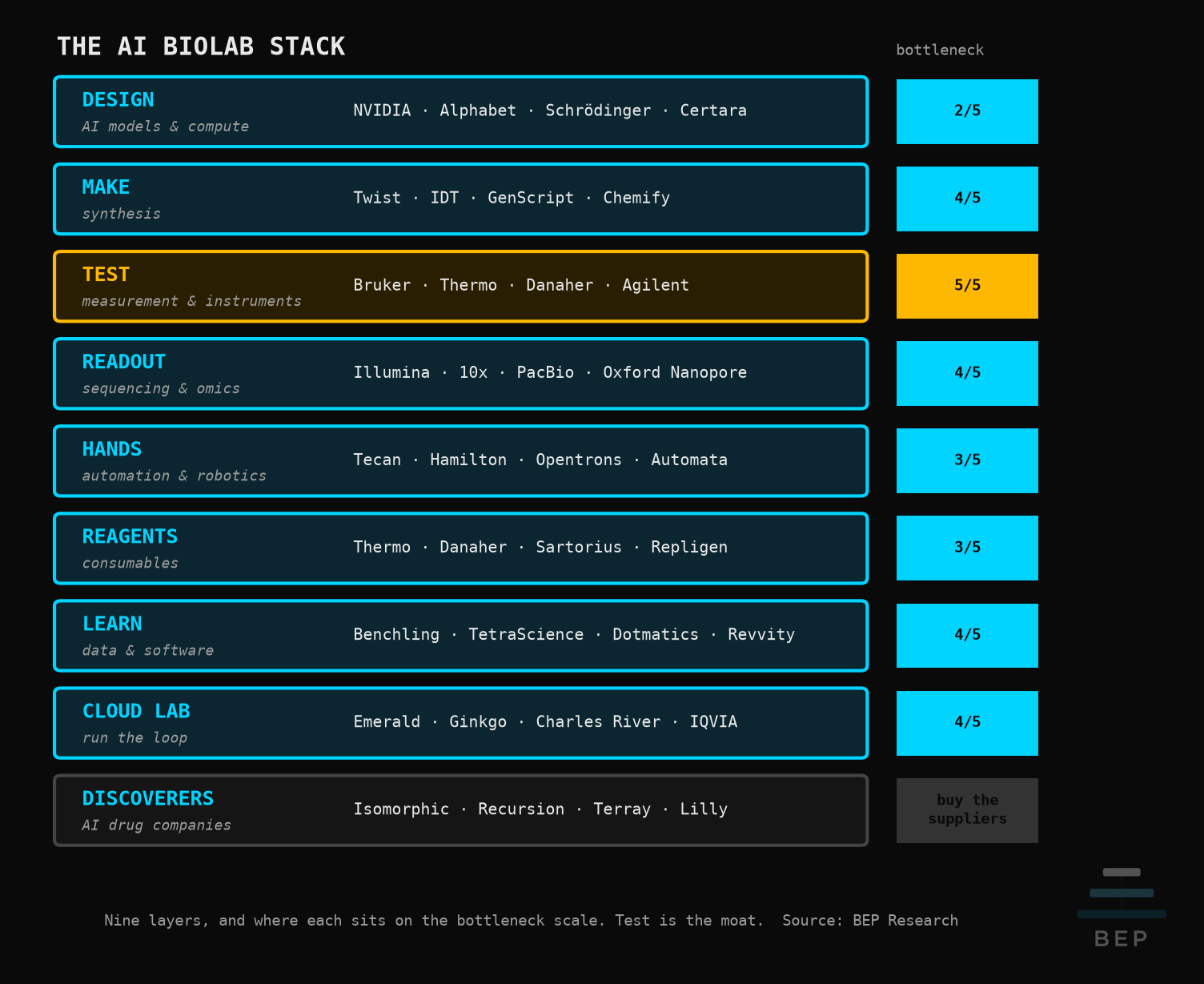
Put those together and the center of gravity is visibly shifting from building the model to running the experiment. That is the argument of this entire primer, and I did not have to make it, because the people with the best information in the field made it with their own careers inside a single week. Note in particular what Dean named the company. The design-make-test-learn loop that organizes this document is not a metaphor I imposed on the industry; it is the thing the industry's most accomplished systems engineer just left the world's best AI lab to go automate.
And the data owners are not going quietly, which is itself the tell that the data is the asset. In early July 2026, on the All-In podcast, David Friedberg, who runs the crop-genomics company Ohalo, described Anthropic quietly approaching large life-sciences companies to pool their proprietary data into a new life-sciences model in exchange for early access and an NDA. His read, and, he said, the read of nearly everyone he had spoken with, was blunt: they are “basically trying to commoditize everyone’s business.” A drug company’s tens of billions of dollars of experiments produce proprietary measured data, and handing it to a model company to blend with everyone else’s gives away the one asset it actually owns. So they are saying no, and increasingly building their own models on their own data instead. That standoff is the whole primer playing out in real time: the people sitting on the data have worked out that it is the one scarce thing, and they are refusing to hand it over.
The inflection is not that a single drug got approved by an AI, and it is worth being precise: as of this writing, no fully AI-designed drug has yet won FDA approval. Anthropic itself said as much while making its case. The inflection is that the loop became industrial. And that gap, enormous model progress on one end, no approved drug on the other, is the whole thesis in miniature: the design step raced ahead, while the wet-lab step that actually validates a molecule, the measurement, is still the scarce, gating, valuable part. So let us walk the machine, layer by layer.
© BEP Holdings · Ben Pouladian. Research and commentary, not investment or medical advice.