BEP Research · Free primer
The Future of Drug Discovery Is AI-Assisted
AI conquered language. Its next inflection is the wet lab, and the moat is the measurement.
How to use this. This is a reference document, not a narrative, and I do not expect anyone to read it end to end in one sitting. It is built so you can jump to whichever layer you care about, get oriented in a few minutes, and leave. If you want the argument without the depth, the Substack post version covers it in about fifteen minutes, and there is a two-page summary if you want only the map. What this document is really for is context. AI moving into biology is going to be a defining theme for the next several years, and when it shows up in a headline or a pitch or an earnings call, the goal is that you already know which layer it touches and whether that layer is defensible.
The framework, if you want to use it yourself. The method behind this primer, how I score a layer, where I look for the bottleneck, and the research hygiene rules that stop the expensive mistakes, is published as a file you can use: tools.bepresearch.com/primer/CLAUDE.md. Save it into a project folder as CLAUDE.md and any agent that reads that convention will pick it up, then point it at filings, transcripts or your own notes. It contains the method and no positions, weights, or price targets, on purpose.
A note on method. I used AI, mostly Claude, to help assemble this primer: organizing research, checking my reasoning, drafting and redrafting sections, and arguing with me about the weak parts. Every judgment, every framework, and every remaining error is mine, and the numbers were verified against primary sources. It seems worth saying plainly in a document about AI-assisted work, and honestly it is part of the point. This is what the tools are genuinely good at right now, and it is also a small demonstration of the thesis: the model made the writing faster, and it could not do the thinking, the sourcing, or the standing in a lab in Los Angeles watching the machines run.
I did not come to drug discovery as an investor. I came to it after I lost both of my parents to cancer, and after watching a Phase 2 drug my mother needed stay just out of reach, close enough to have a name, too far to actually get. Standing in that gap, between a drug that exists and a patient who cannot reach it, is what turned a private grief into a question I could not put down: what is actually broken inside biotech, and is any of it about to change?
This primer is the long answer. I went looking with the same lens I bring to semiconductors, where I have spent years mapping the physical layers of the AI buildout, and I found the same structure hiding underneath biology. So I will be upfront that the conviction here is personal. The analysis is not. By the end you will have the whole map: every layer, every company, and where the real constraint sits. The people building this have a slogan for the moment:
“For the first time, biology has the chance to be an engineering discipline rather than a purely empirical one.”
A refrain now repeated by nearly every frontier-lab and instrument CEO pitching the AI-for-science trade in 2026.
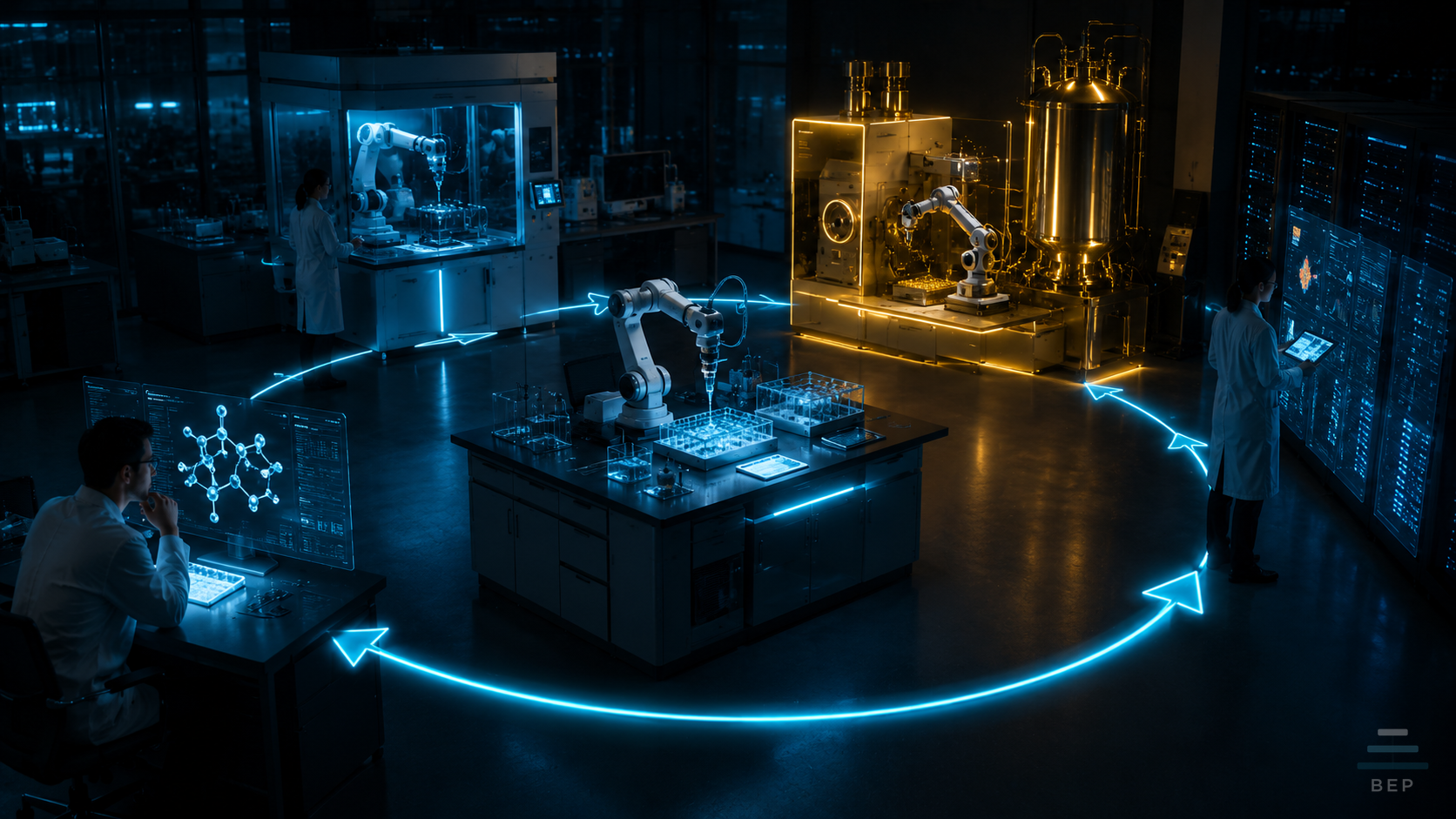
Strip out the slogan and a real claim survives underneath it. For two hundred years, biology advanced by trial, luck, and the slow accretion of experiments. The real change is quieter than a model guessing a protein structure. It is that the loop between guessing and knowing is finally closing, and the machine on both ends of that loop is being rebuilt company by company, instrument by instrument, in a stack most technology investors have never looked at.
The market has decided the AI story is a compute story. It was right about the last three years, and I think it is about to be wrong about the next three. The token machine got built, the datacenter supply chain got repriced, and the picks-and-shovels of language-model training made fortunes. That trade is mature. The next one is quieter, older, and hides inside companies that make mass spectrometers and pipette tips.
This is a primer, not a pitch. My aim is that by the end you understand the entire AI biolab as a system: every layer, who occupies it, and how the pieces feed each other. Only then, behind the paywall, where I think the money is and how I would express it in twenty names.
- Part One · How the Lab Works
- How a Drug Actually Gets Made (and Why It's So Hard)
- The Reframe: The Lab Is a Loop
- Why Now: The Inflection Is Real, and It Is Dated
- Part Two · The Stack, Layer by Layer
- The Design Layer — Teaching a Computer to Invent a Molecule map ↗
- The Make Layer: Building What the AI Designed map ↗
- The Test Layer — Why Measurement Is the Moat map ↗
- The Readout Layer: Reading Biology Directly map ↗
- The Hands — Automation, Robotics, and the Orchestration Layer map ↗
- The Reagents Layer — The Recurring-Revenue Floor map ↗
- The Learn Layer — Data, Software, and the Scarcest Asset in the Lab map ↗
- The Cloud Lab — Running the Whole Loop as a Service map ↗
- The Discoverers — The Tenants Who Run the Loop to Find Drugs map ↗
The AI-Science Basket, marked to market →
The full twenty-name basket — every holding and weight — tracked live against the S&P 500 and XBI.
This primer is free. The full investment case — how to size it, entry, and the ranked bears — is the paid Part Three. Read it on Substack →